
If you’ve typed “the new rule will take affect” and then paused, wondering if that’s right — it isn’t correct. The right phrase means something is starting to work or become active.
This mix-up trips up even confident writers because affect and effect sound nearly the same when spoken aloud. Below, you’ll get the exact rule, real examples from law, medicine, and tech, plus a memory trick that actually sticks.
What Is the Correct Phrase: Take Effect or Take Affect?
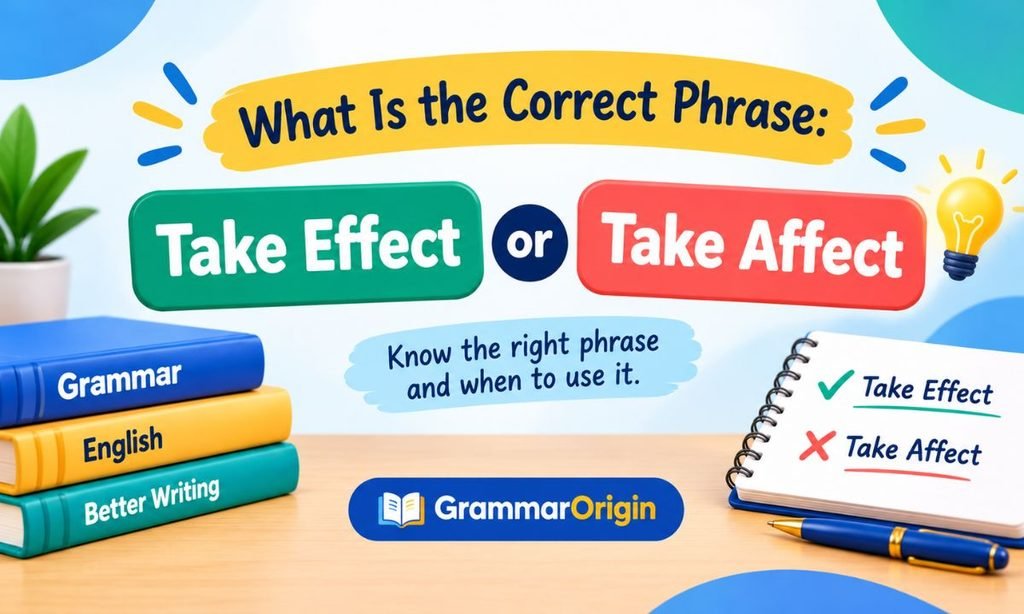
Take effect is correct. Take affect is a common English usage mistake that doesn’t hold up under standard grammar rules.
The phrase describes something beginning to operate, apply, or produce a result. You’ll see this idiomatic expression constantly in news headlines, legal notices, and workplace memos — anywhere a change is about to become active.
Examples of “Take Effect”
- The new parking rules begin this weekend.
- Her promotion starts next pay cycle.
Example: A city council might announce, “The curfew starts at 9 PM,” meaning the rule begins being enforced at that time.
Is “Take Affect” Ever Correct?
No — this version isn’t standard English in any common context. Affect functions as a verb meaning “to influence,” so it doesn’t slot naturally into this expression.
Writers usually land on the wrong version by sound alone, not by grammar logic. Once you separate the two words by function — one names an action, the other names a result — the confusion stops.
Example: “The vaccine will start working in two weeks” uses the correct meaning, even if someone mistakenly writes “affect” instead of “effect.”
Understanding the Difference Between Affect and Effect
These two words carry different jobs in a sentence, and that’s the entire root of the confusion.
Affect Meaning
Affect is almost always a verb. It means to influence, change, or have an impact on something.
Example: Loud construction noise can affect your ability to focus during work calls.
Effect Meaning
Effect is almost always a noun. It names the outcome or result that follows an action.
Example: A pay raise had a noticeable effect on team morale.
Why “Take Effect” Works
This idiom pairs the verb “take” with the noun “effect” to mean “become active” or “go into effect.” Grammatically, you’re not “taking” an action word — you’re triggering a result.
This pairing has existed in English for centuries, which is why it feels so fixed and automatic. Swapping in the verb form breaks that internal logic, even if the sentence still sounds vaguely plausible out loud.
Example: “The discount applies at checkout” carries the same idea — a result becoming active, the same sense captured by phrases like “into effect” or “in effect.”
Take Effect Meaning in Everyday English
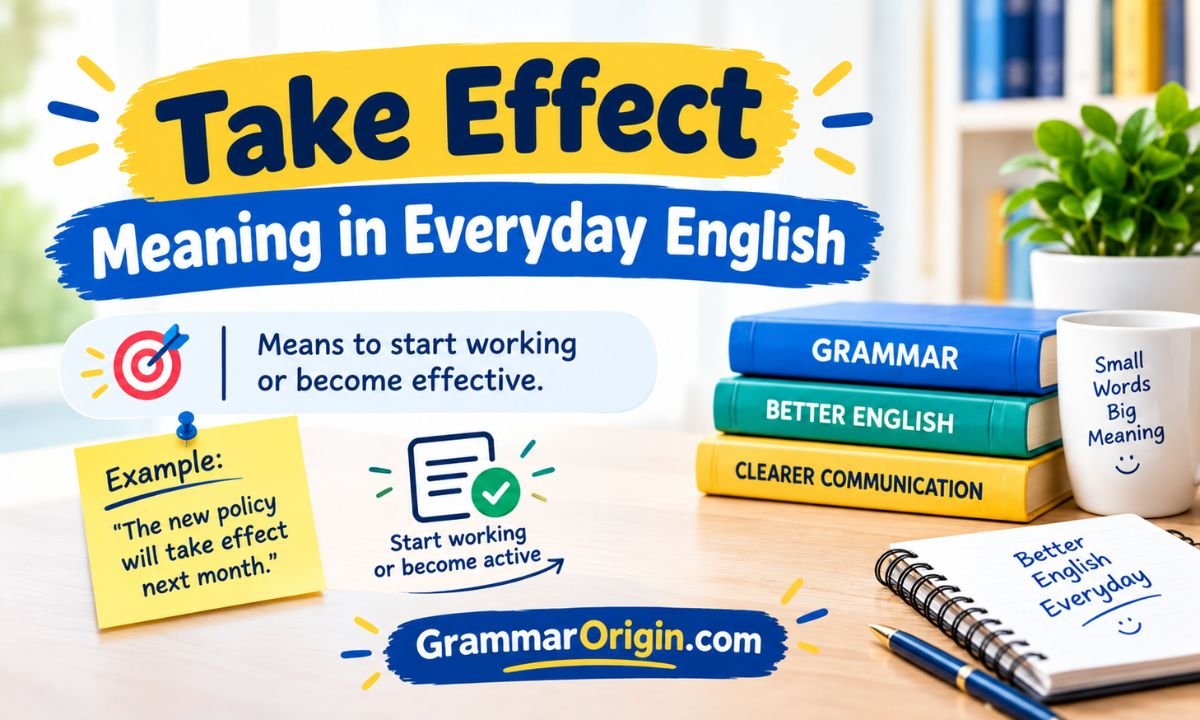
You’ll run into this expression across almost every formal or semi-formal setting where timing matters.
Laws and Regulations
Governments use it to mark exactly when a statute becomes enforceable.
Example: The updated traffic law starts applying on the first of next month.
Medicine and Healthcare
Doctors and pharmacists use it to describe when a drug starts working in the body.
Example: This painkiller usually starts working within twenty minutes.
Business and Workplace Policies
HR teams rely on this phrase when rolling out new internal rules.
Example: The revised remote-work policy begins at the start of the next quarter.
Technology and Software
Tech companies use it constantly for updates, settings, and permission changes.
Example: Your new privacy settings will apply after you restart the app.
Also Read This Other Than or Other Then: Which One Is Correct?
Take Effect vs Take Affect: Quick Comparison Table
| Aspect | Take Effect | Take Affect |
| Grammatically correct | Yes | No |
| Part of speech used | Effect (noun) | Affect (verb, misused) |
| Common in | Laws, medicine, tech, HR | Not standard usage |
| Recommended for writing | Always | Never |
Simple Rule to Remember
Ask: is something becoming active or producing a result? If yes, use the noun form — never the verb form.
Example: “The ban starts Monday” passes the test — a rule is becoming active.
Why Do People Confuse Take Effect and Take Affect?
The mix-up isn’t random; a few specific habits keep causing it.
Similar Pronunciation
Affect and effect share almost the same sound when spoken quickly, so the ear doesn’t catch the difference the way the eye would on a page.
Affect and Effect Are Commonly Mixed Up
Both words can technically work as either noun or verb in rare cases, which makes the simple “always a verb / always a noun” shortcut harder to apply.
Autocorrect Doesn’t Always Help
Spell-checkers flag misspelled words, not wrong words. Since “affect” is spelled correctly on its own, most tools let this error slide right through.
Example: A document can pass a full spellcheck and still carry this exact grammar mistake.
Lack of Grammar Awareness
Many writers never learned the affect-versus-effect rule directly, so they copy whichever version they’ve seen most recently in someone else’s writing — right or wrong.
Real-Life Example: How One Small Grammar Mistake Changed a Professional Email
A team lead once sent a company-wide announcement stating that new expense limits would kick in using the wrong word choice the following Monday. Within an hour, two employees had replied-all pointing out the error, and the thread quietly became the joke of the week.
The mistake didn’t change what anyone understood — everyone knew the new limits were starting Monday regardless. But it did shift how a few people read the announcement itself, treating a routine policy update as slightly less polished than it should have been.
Example takeaway: the fix was simple — swap in the correct word — but the small slip briefly outweighed the actual message.
Grammar Rule: When to Use Affect and Effect
Here’s the rule stripped down to its core.
Affect = Action
Affect describes something happening or changing in real time.
Example: Heavy rain affected the flight schedule all afternoon.
Effect = End Result
Effect names what came out of that action.
Example: The effect of the storm was a full day of delayed flights.
Applying the Rule
Since this idiom is about a result becoming active — not an action happening — the noun is the only word that fits. The same logic applies to related expressions like “in effect,” “into effect,” and “effect change,” which all lean on effect as a noun or a formal verb meaning “to bring about.”
Example: “The new fee structure will apply in March” is correct because a result (the fee structure) becomes active.
Statistics: Why Grammar Accuracy Matters in 2025–2026
Grammar precision still shapes how professional writing gets judged, especially online where readers decide trust within seconds.
Key Findings
- Writing-quality surveys consistently link grammar errors to a lower perceived level of professionalism in business emails and proposals.
- Style guides like Purdue OWL and dictionaries such as Merriam-Webster continue listing affect/effect confusion among the most searched English usage questions.
- Editors and hiring managers commonly cite small usage errors — not just spelling — as a factor in how carefully written content gets judged.
For anyone publishing content, fixing small idiom errors like this one is a low-effort way to protect your writing’s credibility.
Common Examples of Take Effect
A quick reference across common real-world categories.
Government
- The new immigration policy takes effect in October.
Healthcare
- The updated vaccination guidelines apply this flu season.
Education
- The revised attendance policy takes effect next semester.
Workplace
- The new overtime policy takes effect at the start of the fiscal year.
Technology
- The privacy update takes effect after your next login.
Common Mistakes to Avoid
Three patterns account for most of the errors people make with this phrase.
Also Read This Other Than or Other Then: Which One Is Correct?
Mistake 1: Writing Take Affect
Incorrect: The new rule will take affect Friday. Correct: The new rule will take effect Friday.
Mistake 2: Using Affect as a Noun
Incorrect: The affect of the change surprised everyone. Correct: The effect of the change surprised everyone.
Mistake 3: Mixing Both Words Randomly
Incorrect: The policy affected an effect on morale. Correct: The policy had an effect on morale.
How to Remember the Difference Forever
A couple of memory tricks make this permanent.
The A-E Rule
Affect starts with A, like Action. Effect starts with E, like End result.
Effect = End Result
If you can swap in the word “result” and the sentence still makes sense, effect is the right choice.
Example: “The result was immediate” works just as well as the original sentence, confirming effect is correct.
Applying the Trick
Example: “The storm affected travel, and the result was a canceled flight” — action first, result second.
Mini Quiz: Take Effect or Take Affect
Quiz 1: Which Phrase Is Correct?
The new policy will take ___ next week. A) affect B) effect Answer: B — a policy becoming active always uses “effect.”
Quiz 2: Spot the Right Word
The medicine should take ___ within an hour. A) affect B) effect Answer: B — the drug is starting to work.
Quiz 3: Affect or Effect?
Stress can ___ your sleep quality. A) affect B) effect Answer: A — this describes an action influencing something.
Quiz 4: Fill in the Blank
The updated law will ___ next month. A) take affect B) take effect Answer: B.
Quiz 5: Quick Grammar Challenge
Which word is usually a noun? A) affect B) effect Answer: B — effect names a result.
Quiz 6: Real-Life Scenario
Your manager says, “This starts working Monday.” Which phrase matches? A) take affect B) take effect Answer: B.
Quiz 7: True or False
“Take affect” is acceptable in formal writing. Answer: False.
Quiz 8: Choose the Best Sentence
A) Benefits take affect after 90 days. B) Benefits take effect after 90 days. Answer: B.
Quiz 9: Meaning Check
“Take effect” means: A) to influence B) to become active Answer: B.
Quiz 10: Grammar Detective
Find the error: “The update will take affect tonight.” Answer: “affect” should be “effect.”
Quiz 11: Memory Trick Test
Which pairing is correct? A) Affect = Action, Effect = Result B) Affect = Result, Effect = Action Answer: A.
Final Bonus Quiz
“This change will take ___ starting tomorrow.” A) affect B) effect Answer: B — this is the exact idiom, and effect is always the correct choice here.
Frequently Asked Questions
Is it “take effect” or “take affect”?
It’s always “take effect.” The other version isn’t standard grammar in any common context.
What does “take effect” mean?
It means something is starting to operate, apply, or produce a result — like a law, rule, or medication beginning to work.
Why do people write “take affect” instead?
Mostly because the two words sound alike when spoken, and spellcheckers don’t flag “affect” since it’s a real, correctly spelled word.
Is affect always a verb?
Almost always in everyday writing. Rare exceptions exist in psychology, where it’s used as a noun describing emotional expression.
Is effect always a noun?
In most everyday writing, yes — it refers to a result. It can occasionally work as a verb meaning “to bring about,” as in “effect change.”
How can I remember the difference quickly?
Link affect to action and effect to end result — both letter pairs (A/Action, E/End result) match, which makes the rule easy to recall under pressure.
Does this change will take effect or affect?
It’s “take effect.” Any version of this sentence — present, past, or future tense — always uses “effect,” never “affect.”
Summary
The rule is simple once it clicks: the noun form is correct, and the verb form isn’t standard English in this idiom. Effect works because it names a result becoming active — laws, medications, and policies all take effect — never the incorrect version.
Keep the Action-versus-End-result trick handy, and this mix-up won’t trip you up again — whether you’re writing a company memo, a blog post, or just texting a friend about when a new rule kicks in.

Muhammad Waqas is an English language teacher and grammar expert with over 8 years of experience helping students and professionals improve their writing skills. He specializes in English grammar, vocabulary, communication, and practical language learning. Through GrammarOrigin, Waqas shares clear, easy-to-understand content that helps readers write and speak English with confidence.