
If you’ve ever paused mid-sentence wondering whether to write “I run” or “I ran,” you’re not alone. The past tense of run trips up native speakers and learners alike because it breaks the usual rulebook.
This guide walks through exactly when to use “ran,” when to use “run,” and why English handles this common verb so differently from regular ones — with a full verb table, real examples, and a quiz to test yourself.
Quick Answer
The past tense of run is ran, and the past participle is also run — spelled the same as the base form but used in different grammar situations. Getting this verb tense pair right comes down to one simple test: check what comes before it.
What is the past tense of run?
The simple past tense of run is ran. You’d use it for a finished action, like “She ran to the store before it closed.”
Ran never appears with a helping verb like have, has, or had — it stands alone as the main verb of the sentence.
What is the past participle of run?
The past participle of run is run, identical in spelling to the base form. It shows up in phrases like “I have run” or “the shop was run by two sisters.”
Unlike ran, this form always needs a helper verb — also called an auxiliary verb — sitting in front of it to make grammatical sense.
One-Sentence Rule You Can Remember Forever
Here’s the shortcut: no helper verb means ran, a helper verb means run. That’s really the whole rule boiled down to one line.
Test it yourself — “Yesterday I ___ five miles” needs ran, while “I have ___ five miles” needs run.
Why “Run” Becomes “Ran” (The Real Grammar Rule)

Run changes to ran because it’s part of a small group of English verbs that shift their internal vowel instead of adding an ending. This pattern goes back centuries and never fully disappeared from the language.
Understanding the mechanics behind it makes the whole “ran vs run” question much less confusing.
Irregular Verbs Explained
Regular verbs form their past tense by tacking on -ed: walk turns into walked, cook turns into cooked. Run refuses to follow that pattern.
Instead of gaining an ending, the vowel inside the word shifts — u becomes a, and run becomes ran. This makes it an irregular verb, a category English has hundreds of.
Strong vs Weak Verbs
Linguists sometimes split verbs into two older categories: strong verbs and weak verbs. Weak verbs are the -ed crowd — played, jumped, listened.
Strong verbs, on the other hand, change their vowel sound to mark tense, and run belongs firmly in this camp.
| Verb type | Method | Example |
| Weak verb | Adds -ed | walk → walked |
| Strong verb | Vowel changes | run → ran |
| Strong verb | Vowel changes | sing → sang |
Why English Doesn’t Add -ed Here
Run traces back to Old English, long before the modern -ed pattern became the default way to build a past tense. Vowel-shifting verbs like this one simply survived the centuries intact.
That’s also why “runned” sounds so obviously wrong to a native ear — it’s trying to force a modern rule onto a much older word.
All Forms of “Run” (V1, V2, V3, V4, V5 Table)
Run has five distinct grammatical forms, even though two of them are spelled identically. This is essentially the full verb conjugation of run, and seeing all five side by side clears up most of the remaining confusion.
| Form | Label | Word | Example |
| V1 | Base form | run | I run every morning. |
| V2 | Simple past | ran | She ran late yesterday. |
| V3 | Past participle | run | We have run this test twice. |
| V4 | Present participle | running | He is running now. |
| V5 | Third-person singular | runs | The dog runs in circles. |
Notice that V1 and V3 share the exact same spelling — that overlap is the single biggest source of ran/run mistakes.
When to Use “Ran” vs “Run”
The choice between these two forms depends entirely on the sentence structure around them, not on meaning. Once you know what signal to look for, picking the right word becomes automatic.
Below are the four grammar situations where this choice comes up most often.
Simple Past Examples
Use ran when describing a completed action with no helping verb attached. These sentences usually pair with time markers like yesterday, last week, or in 2019.
- I ran three miles this morning.
- They ran out of the building during the fire drill.
- She ran the numbers before signing the contract.
Present Perfect Examples
Use run after have or has to connect a past action to the present moment. This construction is common when talking about experience or ongoing results.
- I have run this route a hundred times.
- She has run her own bakery for six years.
- They have run into the same problem twice this month.
Past Perfect Examples
Use run after had when one past action happened before another past action. This form helps sequence two events that both already occurred.
- He had run out of patience before the meeting even started.
- We had run the errand before the rain began.
- She had run the marathon once before, so the second felt easier.
Passive Voice Examples
Use run after forms of be — is, was, were — when the subject receives the action instead of performing it. This shows up constantly in business and formal writing.
- The company is run by two co-founders.
- The event was run entirely by volunteers.
- These trials are run under strict safety conditions.
Common Mistakes (And How to Avoid Them)
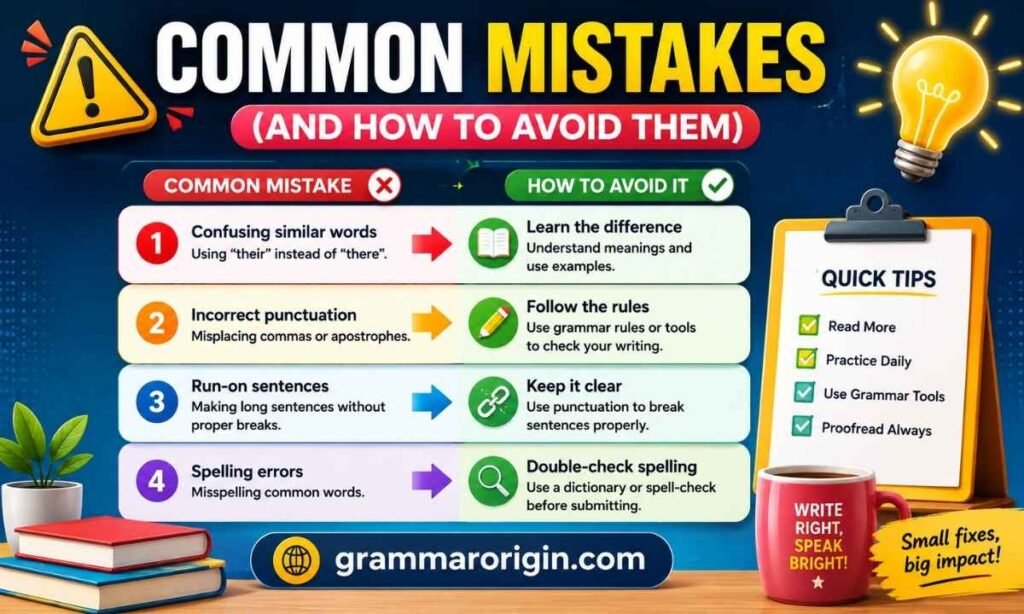
Most ran/run errors come from crossing the wires between these two forms in the wrong grammar context. Catching the pattern once usually fixes it for good.
- Wrong: “I have ran five miles.” Right: “I have run five miles” — have always pairs with run.
- Wrong: “Yesterday I run to school.” Right: “Yesterday I ran to school” — no helper verb means ran.
- Wrong: “The store was ran by my uncle.” Right: “The store was run by my uncle” — passive voice needs run.
Why Learners Confuse Them
Part of the trouble is that run and its past participle look identical, so the base form and the “correct after have” form feel interchangeable even though they’re not. English learners coming from languages with more regular verb systems often expect an -ed ending that simply never arrives.
Speed of speech doesn’t help either — ran and run can blur together when spoken quickly, especially in casual conversation.
Memory Trick That Makes It Stick
Try pairing run with other verbs that follow the same u-to-a vowel shift, since your brain remembers patterns better than isolated exceptions. Sing/sang, begin/began, and swim/swam all move the same way run does.
Another trick: say “yesterday I ran” and “I have run” out loud a few times back to back. Hearing the rhythm helps the rule stick far better than reading it silently ever will.
Also Read This Oxymoron vs Juxtaposition
10 Real-Life Example Sentences

Seeing both forms across a range of everyday situations makes the pattern feel natural rather than mechanical.
- I ran into an old classmate at the airport.
- She has run this department since 2018.
- They ran a background check before the interview.
- We had run out of coffee by Tuesday morning.
- The marathon is run every October in this city.
- He ran straight past me without saying hello.
- I have run every version of this report twice.
- The old mill was run entirely by water power.
- She ran her first 5K last weekend.
- They’ve run this promotion for three years now.
Practice Quiz (Mini Test)
Pick ran or run for each sentence below, then check your answers underneath.
- Yesterday, the kids ___ around the yard for hours.
- I have never ___ a marathon before.
- The bakery had ___ out of bread by noon.
- This shop is ___ by a father-and-son team.
- She ___ straight home after the call.
Answers: 1) ran, 2) run, 3) run, 4) run, 5) ran
Past tense of run in english
For English learners specifically, the past tense of run is one of the first true irregular verbs worth memorizing, since “run” itself is used constantly in everyday speech. Unlike verbs such as “talk” or “watch,” you can’t apply a fixed ending rule here.
The safest approach for new learners is to memorize run-ran-run as a fixed three-word set, the same way native speakers do with sing-sang-sung.
Past tense of run pronunciation
Ran is pronounced with a short “a” sound, rhyming with words like “can” or “man” — phonetically it’s roughly /ræn/. Run, by contrast, uses a short “u” sound, rhyming with “fun” or “sun,” phonetically close to /rʌn/.
Saying both words side by side — ran, run, ran, run — is one of the fastest ways to train your ear to catch the difference in fast speech, where the two can otherwise sound similar.
Future tense of run
The future tense of run is “will run,” formed by adding “will” before the base form rather than changing the verb itself. For example: “I will run the marathon next spring.”
Because future tense relies on the helper word “will” rather than a verb-ending change, run stays in its base form here — no irregular twist needed at all.
Also Read This Oxymoron vs Juxtaposition
Present tense of run
The present tense of run is “run” for most subjects and “runs” for third-person singular subjects like he, she, or it. “I run every morning” and “She runs every morning” show the only variation this tense has.
This is actually the most predictable of all the tenses covered here — the irregularity only shows up once you shift into the past.
Past tense of run out
The past tense of “run out” follows the same rule as run on its own: “ran out” for simple past, and “run out” after a helper verb. “We ran out of milk this morning” uses simple past, while “We have run out of milk” uses the present perfect form.
This phrasal verb trips people up because the two words feel like one unit, but the irregular change still only happens to “run” itself — “out” never changes at all.
Frequently Asked Questions
Is “runned” ever correct?
No. Runned is not a standard English word in any context, formal or casual. The correct forms are always ran for simple past and run for the past participle.
Is it “have run” or “have ran”?
It’s always “have run.” The word have signals that you need the past participle, and the past participle of run is run, not ran.
Is it “was run” or “was ran”?
The correct passive voice form is “was run,” as in “the shop was run by two brothers.” Passive voice always calls for the past participle, never the simple past form ran.
Why does run not follow the normal -ed pattern?
Run is an irregular verb that changes its vowel sound instead of taking an -ed ending, a pattern inherited from much older stages of English. This vowel-shift group includes many other common verbs like sing, swim, and begin.
Can “ran” and “run” ever be used interchangeably?
No, they serve different grammatical roles and aren’t interchangeable despite both relating to the same base verb. Ran stands alone as simple past, while run always needs a helping verb or functions as the base/present form.
What’s the fastest way to test which form I need?
Look immediately to the left of the verb — if there’s no helper verb like have, has, had, is, was, or were, use ran. If one of those words is sitting right there, use run instead.
Does this rule apply to phrasal verbs like “run out” or “run into”?
Yes, phrasal verbs built on run follow the exact same ran/run pattern as the verb alone. “Ran into” and “have run into,” or “ran out” and “have run out,” both work the same way as the base verb.
Final Thoughts
The past tense of run comes down to one reliable check: no helper verb means ran, and a helper verb like have, has, had, is, or was means run. Once that distinction clicks, sentences that used to feel like a coin flip become second nature.
Run’s irregular pattern isn’t random — it’s a leftover from an older stage of English shared by verbs like sing and swim. Keep that connection in mind, and the ran-versus-run question won’t trip you up again.

Muhammad Waqas is an English language teacher and grammar expert with over 8 years of experience helping students and professionals improve their writing skills. He specializes in English grammar, vocabulary, communication, and practical language learning. Through GrammarOrigin, Waqas shares clear, easy-to-understand content that helps readers write and speak English with confidence.