
“We did it ourself” or “we did it ourselves”? If you’ve paused over that sentence, you’re not making a silly mistake — you’re bumping into one of English’s oldest grammatical leftovers. Ourselves vs ourself is a real distinction, not a typo, and it goes back to how kings, editors, and everyday speakers have used the word “we” across centuries.
This guide breaks down exactly when each form belongs, why “ourself” hasn’t fully disappeared, and how to never second-guess yourself again. You’ll get clear rules, real examples, comparison tables, and answers to the exact questions people search for most.
Understanding Reflexive Pronouns
A reflexive pronoun sends the action of a verb back onto the person doing it. When you say “I hurt myself,” the doer and the receiver of the action are the same person.
English builds these pronouns from possessive or object forms plus “-self” or “-selves.” Singular subjects take “-self” (myself, yourself, himself), while plural subjects take “-selves” (ourselves, yourselves, themselves).
| Subject | Reflexive Form |
| I | myself |
| You (one person) | yourself |
| He/She/It | himself/herself/itself |
| We | ourselves |
| You (multiple people) | yourselves |
| They | themselves |
That table looks tidy, but “we” hides an exception most learners never hear about — which is exactly where “ourself” comes from.
Dictionary Definitions (Merriam-Webster/Oxford View)
Major dictionaries agree that “ourselves” is the standard reflexive form of “we,” while “ourself” is labeled archaic or restricted to formal usage. Merriam-Webster lists “ourself” as a rare singular variant tied to formal or literary speech, not everyday grammar.
Oxford’s guidance follows the same pattern: “ourselves” for the plural, and “ourself” flagged as an older form once used when a single speaker addressed others as “we.” Neither dictionary treats “ourself” as flatly wrong — both treat it as a narrow, context-dependent exception.
The Basic Distinction Between ‘Ourselves’ and ‘Ourself’
“Ourselves” is the reflexive pronoun for plural subjects — it’s what you use nearly every time you write or speak as “we.” “Ourself” is a singular reflexive form, reserved almost entirely for one person speaking formally as “we.”
Think of it this way: if two or more people are involved, “ourselves” is correct. If a single speaker is using the royal or editorial “we” to represent an office, institution, or formal role, “ourself” can apply.
Also Read This Speech or Speach: Which Spelling Is Correct?
Ourselves vs Ourself Quick Comparison Table
| Pronoun | Grammatical Number | Typical Setting | Example |
| Ourselves | Plural | Everyday speech, business, academic writing | We introduced ourselves at the meeting. |
| Ourself | Singular (rare) | Royal decrees, ceremonial or editorial writing | The monarch addressed ourself to the assembly. |
Historical Context and the ‘Royal We’
“Ourself” survives mainly because of the “royal we,” a tradition where a single monarch speaks as “we” to represent both their personal voice and their office. This habit dates back centuries and still shows up in ceremonial English today.
When a king or queen says “we shall attend ourself,” the plural pronoun “we” refers to one person, so the reflexive form drops the “-s” and becomes “ourself.” It’s a grammatical fingerprint of monarchy, not a mistake.
Editors and institutions borrowed a similar habit, sometimes called the “editorial we,” where a single writer speaks on behalf of a publication or organization. In genuinely institutional writing, however, “ourselves” usually stays correct because the “we” reflects a real group of people, not one voice in disguise.
Usage in Literature and Historical Texts
Writers from earlier centuries used “ourself” deliberately to signal authority, reflection, or formal tone — Shakespeare is the clearest example. In King Lear, the king declares, “We have this present hour declared ourself,” using the singular reflexive to mark his royal identity.
Victorian-era writers occasionally kept the pattern alive in formal essays and official correspondence, where a singular author adopted the plural “we” for gravity. By the 20th century, that habit had mostly faded outside of legal, religious, and monarchical documents.
Modern vs Historical Comparison Table
| Era | Typical Example | Pronoun Used | Purpose |
| 1600s (Shakespearean) | “We shall, ourself, in person, taste the griefs of death.” | Ourself | Royal authority, formal reflection |
| 1800s (Victorian formal writing) | “We must prepare ourself for the task ahead.” | Ourself | Institutional or editorial voice |
| Today | “We prepared ourselves for the task ahead.” | Ourselves | Standard plural agreement |
Correct Usage of ‘Ourselves’ in Modern English
In everyday English, “ourselves” is almost always the right choice whenever “we” refers to more than one person. It applies in casual conversation, business writing, academic papers, and virtually every modern context you’ll encounter.
The rule is simple: match the reflexive pronoun to the actual number of people involved. If “we” means a real group — friends, a team, a company — “ourselves” is the safe and grammatically correct pick.
Key Rules for Using Ourselves:
- Match plural subjects with “ourselves,” never “ourself,” in modern writing.
- Never pair “ourselves” with a single-person subject like “I” — use “myself” instead.
- Use it for emphasis, as in “We ourselves witnessed the event.”
- Apply it to compound subjects: “My colleague and I found ourselves stuck in traffic.”
Common Mistakes Table
| Incorrect | Correct | Why |
| The staff congratulated ourself. | The staff congratulated themselves. | “Staff” is third person, not first person plural. |
| I taught ourselves Spanish. | I taught myself Spanish. | Singular subject needs a singular reflexive. |
| We blamed ourself for the delay. | We blamed ourselves for the delay. | Plural “we” needs “ourselves,” not “ourself.” |
Special Contexts Where ‘Ourself’ Makes Sense
Rare as it is, “ourself” still fits a handful of specific situations where a single voice speaks formally as “we.” These aren’t grammar errors — they’re deliberate, tradition-bound choices.
- Royal or ceremonial speech, where a monarch represents both self and office.
- Formal editorial writing, when one author writes on behalf of an institution.
- Certain historical or literary quotations meant to preserve period-accurate tone.
Outside these narrow lanes, “ourself” tends to sound outdated or overly formal in ordinary writing, so it’s worth using sparingly and intentionally.
Ourself vs Myself: Clearing the Confusion
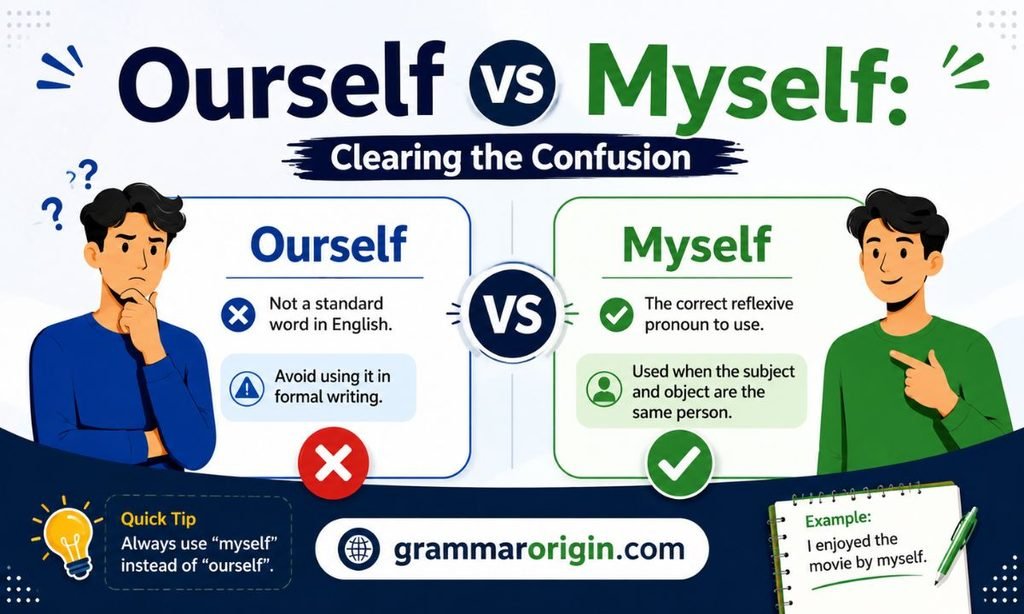
“Ourself” is not simply a fancy version of “myself” — the two serve different grammatical roles even though both refer to a single speaker. “Myself” pairs with the first-person singular “I,” while “ourself” pairs only with the royal or editorial “we.”
You’d never say “myself will attend the ceremony,” because “myself” can’t stand in as a subject pronoun. “Ourself,” by contrast, only appears as an object reflecting back on a singular “we” — a narrow, formal use case that “myself” doesn’t share.
Examples of Correct “Ourself” Usage Today
- The committee, speaking as one body, described ourself as fully accountable.
- In the royal address, the queen referred to ourself with quiet resolve.
- As a single publication, we sometimes present ourself as the voice of the newsroom.
Notice how each example ties “we” to a single formal entity — a monarch, a unified committee voice, or an institution speaking as one. That single-entity link is what makes “ourself” grammatically defensible here.
Is ourself grammatically incorrect?
No — “ourself” isn’t incorrect, but it’s extremely limited in where it belongs. It’s grammatically valid only when “we” refers to a single formal speaker, such as royalty or an institutional voice.
Outside ceremonial, royal, or historical writing, using “ourself” for an everyday plural subject is considered a mistake. Style guides and dictionaries treat it as archaic rather than banned, which is an important distinction for writers who want precision.
Do you say selfs or selves?
You say “selves,” never “selfs” — “self” follows an irregular plural pattern, much like “leaf” becomes “leaves.” This irregular shift is exactly why “ourselves,” “yourselves,” and “themselves” all end in “-selves,” not “-selfs.”
“Selfs” simply isn’t a recognized English word, so it never appears in standard writing or speech. If you’re ever unsure, remember that reflexive plural pronouns always borrow this “-ves” ending from the noun “self.”
Ourselves vs Ourself Common Misconceptions and Grammar Myths
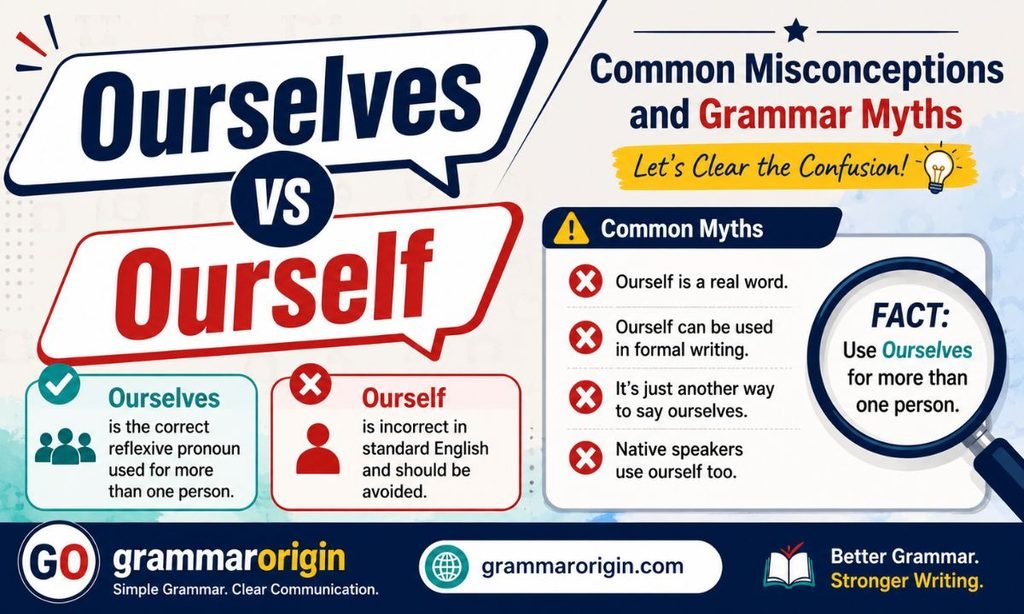
Several persistent myths cloud this topic, and clearing them up makes the whole rule easier to remember.
- Myth: “Ourself” is always wrong. Reality: it’s valid in narrow royal or formal contexts.
- Myth: “Ourselves” can describe one person. Reality: it strictly requires a plural subject.
- Myth: The two words are interchangeable. Reality: swapping them changes both grammar and tone.
- Myth: “Ourself” is pure Old English. Reality: it still shows up occasionally in ceremonial modern writing.
Practical Tips for Correct Pronoun Usage
A few quick habits will keep you consistent every time you write.
- Ask whether “we” truly represents more than one person — if yes, use “ourselves.”
- Reserve “ourself” for deliberate royal, ceremonial, or historical tone.
- When in doubt, default to “ourselves” — it’s correct in the overwhelming majority of situations.
- Read your sentence aloud; “ourself” attached to an obvious group will sound off immediately.
Mnemonic Trick
Picture a crown: one monarch, one “ourself.” Picture a crowd: many people, many “selves,” so “ourselves.” The image alone solves most mix-ups instantly.
Also Read This Speech or Speach: Which Spelling Is Correct?
ourself and ourselves examples
Seeing both forms side by side makes the contrast click faster than any rule.
- Ourselves: “We treated ourselves to dinner after the long week.”
- Ourself: “The king reminded ourself of his duty to the realm.”
- Ourselves: “We should be proud of ourselves for finishing the project.”
- Ourself: “In this formal statement, we present ourself as fully transparent.”
ourself meaning
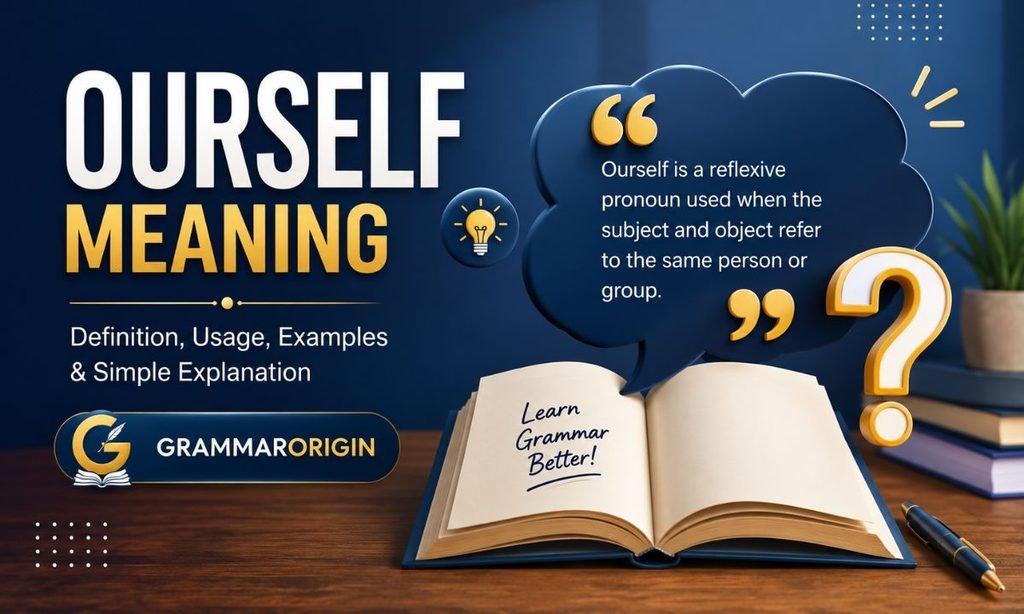
“Ourself” means “myself,” but spoken through the formal or royal “we” rather than the ordinary first person “I.” It’s a reflexive pronoun that reflects the action of a sentence back onto a single speaker who is representing themselves as a plural entity.
This meaning only holds in ceremonial, editorial, or historical contexts — in casual modern English, “ourself” carries no everyday use.
yourself or yourselves
“Yourself” is singular, for one person, while “yourselves” is plural, for two or more people — the same logic that separates “ourself” from “ourselves.” “Are you taking care of yourself?” addresses one person; “Are you taking care of yourselves?” addresses a group.
This pair follows standard modern grammar without the royal exception, since “you” doesn’t carry the same ceremonial baggage that “we” does.
ourself examples
Beyond the royal register, a few more real-world style examples show how “ourself” typically appears in writing.
- “We hereby declare ourself satisfied with the terms of this agreement.”
- “As an institution, we sometimes describe ourself in the singular for formal clarity.”
- “The board, acting as a single voice, presented ourself to the shareholders.”
is ourself a word
Yes, “ourself” is a real, dictionary-recognized word, though it’s labeled rare or archaic in most modern usage guides. It hasn’t vanished from the language — it’s simply confined to a small set of formal and historical situations.
Calling it “not a word” is a common misconception; the more accurate description is that it’s a limited-use word rather than a nonexistent one.
ourselves sentence
A natural, everyday sentence puts “ourselves” to work without any confusion: “We finally allowed ourselves a break after finishing the report.” Notice the plural subject “we” pairs cleanly with the plural reflexive “ourselves.”
Another example: “We should ask ourselves what really matters before making this decision.” Both sentences show the standard, safe, modern usage that covers nearly all real-world writing.
ourselves pronunciation
“Ourselves” is pronounced /ɑːrˈsɛlvz/ in American English and /aʊəˈsɛlvz/ in British English, with stress falling on the second syllable, “selves.” The “our” portion softens slightly in fast speech, almost blending into “ar” or “ow-uh.”
Saying it slowly as “our-SELVES” helps lock in both the correct stress and the “-ves” ending that so many learners accidentally drop.
ourselves vs us
“Ourselves” is a reflexive pronoun that refers back to the subject “we,” while “us” is an object pronoun that simply receives an action without reflecting back on the doer. “We treated ourselves” means the treating and the receiving involve the same people; “They treated us” means someone else did the treating.
A quick test: if the subject and object of the sentence are the same people, use “ourselves.” If someone else is acting on the group, “us” is correct — “Give the tickets to us,” not “Give the tickets to ourselves.”
What does “ourselves” mean?
“Ourselves” means the group performing an action is the same group receiving that action, or it adds emphasis to a statement made by that group. It’s the plural reflexive form of “we,” used whenever more than one person is both the doer and the receiver of a verb’s action.
It can also intensify a sentence, as in “We ourselves built this company from nothing,” where “ourselves” underscores that no one else was involved.
When should we use myself?
Use “myself” only when the subject of the sentence is the singular “I,” and the action reflects back onto that same person. “I taught myself piano” is correct because “I” and “myself” refer to the identical person.
Avoid using “myself” as a stand-in for “I” or “me” in compound subjects, such as “Myself and John went to the store” — that’s a common but incorrect pattern; “John and I went to the store” is the accurate version.
Frequently Asked Questions
What is the difference between “ourselves” and “ourself”?
“Ourselves” is the standard plural reflexive pronoun for group subjects, while “ourself” is a rare singular form reserved for royal, editorial, or ceremonial “we.” Modern everyday writing almost always calls for “ourselves.”
Is “ourself” grammatically correct?
Yes, but only in narrow formal contexts where a single speaker uses the plural “we,” such as monarchs or institutional voices. In ordinary writing, it reads as archaic or mistaken.
Can “ourselves” ever refer to one person?
No, “ourselves” strictly requires a plural subject. A single person should use “myself,” not “ourselves,” regardless of formality.
Why do monarchs say “ourself” instead of “ourselves”?
Monarchs traditionally use the royal “we” to represent both their personal identity and their official role, and “ourself” matches that singular-yet-plural voice grammatically. It’s a centuries-old linguistic convention, not a grammar error.
How can I remember which form to use?
If more than one person is involved, choose “ourselves” — that covers roughly every everyday sentence. Save “ourself” only for deliberate formal or historical tone.
Does “ourself” appear anywhere in modern writing?
Occasionally, yes — in ceremonial speeches, legal proclamations, and some editorial writing where a single voice speaks formally as “we.” It’s uncommon but not extinct.
Is “selfs” ever correct instead of “selves”?
No, “selfs” is not a standard English word. The correct irregular plural is always “selves,” which is why we get “ourselves,” “yourselves,” and “themselves.”
Summary
The choice between ourselves and ourself really comes down to counting people and reading the room. Use “ourselves” for virtually every modern, everyday sentence involving more than one person, and save “ourself” for the rare royal, ceremonial, or historical voice speaking as a singular “we.”
Once you internalize that one distinction, the confusion disappears for good. Trust “ourselves” as your default, and reach for “ourself” only when the context genuinely calls for that formal, centuries-old tone.

Muhammad Waqas is an English language teacher and grammar expert with over 8 years of experience helping students and professionals improve their writing skills. He specializes in English grammar, vocabulary, communication, and practical language learning. Through GrammarOrigin, Waqas shares clear, easy-to-understand content that helps readers write and speak English with confidence.