
Loosing vs Losing If you’ve ever paused mid-sentence wondering which spelling to use, here’s the short answer. Losing is the word you need almost every time, and loosing is a real but rare word with a completely different meaning.
The two look nearly identical and sound alike when spoken, which is exactly why they get mixed up so often. This guide breaks down the meaning, the root verbs, common synonyms, and simple rules so you pick the right one every time.
Comparison Overview
Losing relates to failure, defeat, or misplacing something. Loosing relates to releasing or setting something free. They come from two different base verbs, which is the real reason they aren’t interchangeable.
Example: “She is losing the race” and “He is loosing the dog from its leash” use two completely different words for two completely different actions.
Major dictionaries, including Merriam-Webster and the Oxford English Dictionary, list both words separately with their own distinct meanings, so neither spelling is a shortcut or informal version of the other.
Definition of Loosing
Loosing is the present participle of the verb “loose,” which means to release, untie, or set something free. It’s grammatically valid, just uncommon in everyday writing.
You’ll mostly see it in specific situations, such as archery, animal handling, or older, more formal English.
Example: “The archer is loosing arrows toward the target” uses loosing correctly, since it describes an act of release.
Words with a similar meaning include release, untie, unbind, and free, which can help you recognize the right context when you see loosing in older or formal writing.
Definition of Losing
Losing is the present participle of the verb “lose,” meaning to fail to keep something, to be defeated, or to misplace something. It’s one of the most common words in everyday English.
It covers a wide range of situations, from games and money to focus, patience, and even people.
Example: “I keep losing my keys” and “She’s losing her patience” both use the word correctly, even though the two sentences describe very different kinds of loss.
Related words include defeat, forfeit, misplace, and decline, all of which point back to the same core idea of failing to keep or hold onto something.
Main Differences Between Loosing vs Losing
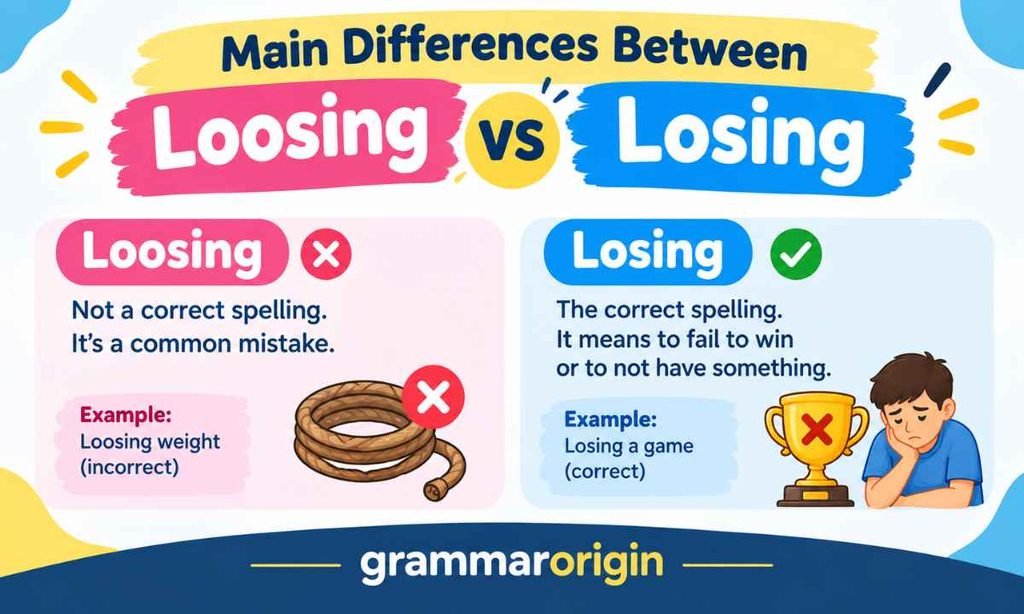
The core difference is meaning, not just spelling. Losing is about failure or loss, while loosing is about release.
| Feature | Loosing | Losing |
| Base verb | Loose | Lose |
| Meaning | To release or set free | To fail, misplace, or be defeated |
| Everyday use | Rare | Very common |
| Typical context | Physical release, archaic writing | Games, objects, emotions, money |
Example: “The team is losing the match” is right for a competition. “The handler is loosing the falcon” is right for a release, and swapping the two words would confuse the meaning entirely.
Grammar Guide
Both words follow the same “-ing” pattern, but they come from different roots, and that root is what decides the correct spelling.
Also Read This Privilege or Priviledge? Correct Spelling Explained
How each term is used in sentences
Loosing follows this pattern: Subject + is/was + loosing + object, as in “The guard is loosing the chains.”
Losing follows a similar pattern: Subject + is/was + losing + object, as in “He is losing his temper.” The structure is the same, but the meaning depends entirely on the base verb.
Example: Swap “losing” for “loosing” in “I am losing my mind,” and the sentence stops making sense, since nothing is being physically released.
Common mistakes learners make
- Writing “loosing” when talking about failure, defeat, or misplacing something.
- Assuming the extra “o” makes the word look more correct, since “loose” also has two o’s.
- Trusting autocorrect completely, since both words are real and it won’t always catch the error.
- Mixing up “loose” (an adjective) with “lose” (a verb) before even reaching the “-ing” form.
Example: A learner writes “I’m loosing weight,” when “I’m losing weight” is what they actually mean.
Simple rules to remember
- If you mean to fail, misplace, or be defeated, use losing.
- If you mean to release or set free, use loosing.
- Check the base verb first: lose becomes losing, loose becomes loosing.
- When unsure, losing is the safer default, since it covers far more everyday situations.
Quick tips for writing and speaking
- Say the sentence out loud and ask what’s actually happening: failing, or releasing?
- Remember that “lose” has one “o,” and so does “losing.“
- Read your writing back once before sending anything formal.
- Keep a short mental list of loosing’s rare use cases, since almost everything else calls for losing.
When to Use Each One
Use losing for failure, defeat, misplacing something, or any kind of decline, whether it’s money, focus, weight, or patience. Use loosing only when something is physically or figuratively being released or untied.
Example: “The company is losing customers” fits a business decline. “The sailor is loosing the ropes” fits a physical release, and neither word could replace the other here.
When NOT to Use Each One
Do not use loosing when you mean failure, defeat, or misplacement. It’s incorrect in those situations, no matter how natural it might look on the page.
Do not use losing when describing an act of release, freeing, or untying something, since that meaning belongs to loosing instead.
Example: “The team is loosing the game” is wrong. “The team is losing the game” is the version that actually makes sense.
Which One to Use (Decision Guide)
Ask yourself one question: is something failing, missing, or being defeated, or is something being released? The first situation calls for losing, and the second calls for loosing.
| Situation | Correct Choice |
| Losing a game or competition | Losing |
| Misplacing an object | Losing |
| Losing focus, patience, or confidence | Losing |
| Releasing an animal or object | Loosing |
| Untying a rope or restraint | Loosing |
| Unsure which one fits | Losing (default) |
Losing vs Loose vs Loosing (The Third Confusing Word)
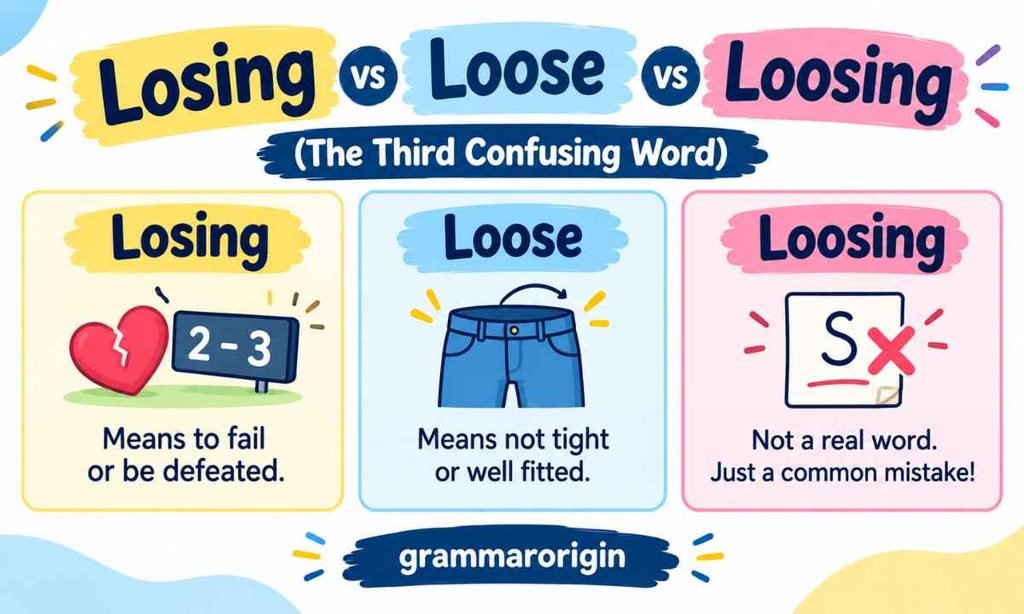
Part of the confusion comes from a third word: “loose,” which is usually an adjective, not a verb form at all. Loose describes something that isn’t tight, while losing and loosing are both verb forms.
| Word | Part of Speech | Past Tense | Meaning | Example |
| Loose | Adjective | Not applicable | Not tight, not secure | The shirt is loose. |
| Lose | Verb (base form) | Lost | To fail or misplace | Don’t lose your ticket. |
| Losing | Verb (present participle) | Lost | Currently failing or misplacing | She is losing the game. |
| Loosing | Verb (present participle) | Loosed | Currently releasing | He is loosing the hounds. |
Example: Confusing “loose” with “lose” at the base-verb stage is often what causes the “-ing” form to go wrong later.
Pronunciation: Why They Sound So Similar
Losing and loosing are pronounced almost the same way, which is a big reason people mix them up in writing even when they know the meaning. Both are said as /ˈluːzɪŋ/, with the spelling being the only real clue that separates them on the page.
Saying a sentence out loud won’t help you choose the right word here, since context and meaning are what actually decide it.
This same kind of mix-up shows up in other word pairs too, such as choose and chose or breath and breathe, where similar sound but different spelling causes the same kind of confusion.
Also Read This Privilege or Priviledge? Correct Spelling Explained
Loosing vs Losing Real-World Practical Examples
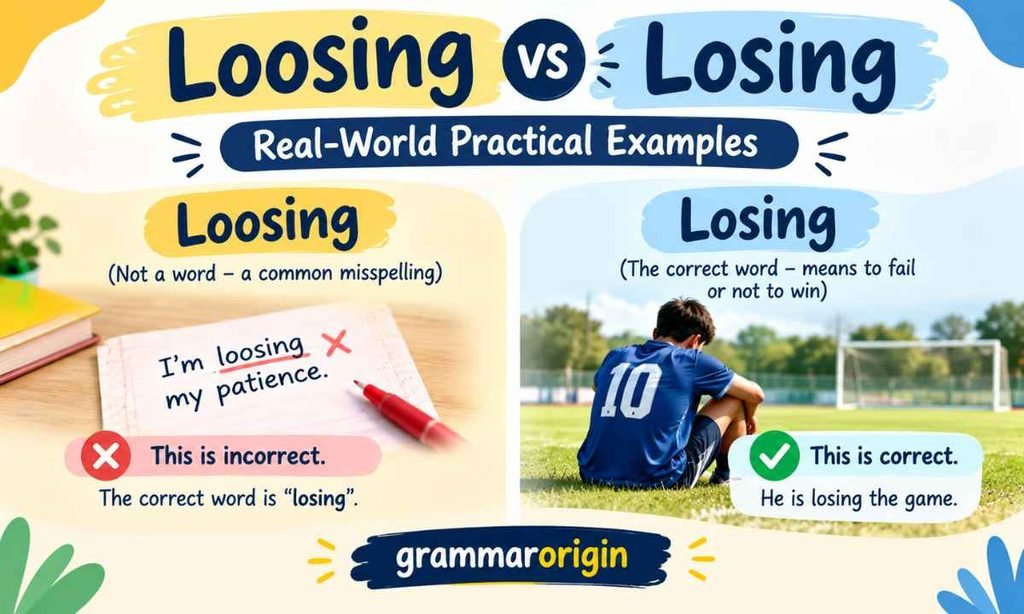
Loosing Examples
- The trainer is loosing the horse into the open field.
- The captain is loosing the sails before departure.
- The handler is loosing the birds after rehabilitation.
- The guard is loosing the chains from the old gate.
- She is loosing the rope to let the balloon rise.
Losing Examples
- He is losing his keys almost every morning.
- They are losing the match in the final minutes.
- She is losing patience with the long delay.
- I keep losing focus while studying at night.
- Losing a person you love is one of life’s hardest experiences, and the word applies to emotional loss just as much as physical loss.
Self-Assessment (Fill in the Blanks)
- I am ______ my phone again today.
- The sailor is ______ the anchor rope.
- They are ______ the game badly.
- She is ______ her temper with the noise.
- The handler is ______ the dogs into the yard.
- He keeps ______ his wallet every week.
- I feel like I’m ______ my mind with all this noise.
- The archer is ______ arrows at the target.
- We are ______ the competition this year.
- Losing someone close to you means ______ them, not releasing them.
Answers
- losing
- loosing
- losing
- losing
- loosing
- losing
- losing
- loosing
- losing
- losing
Final Verdict
Losing is the word you’ll need in almost every situation involving failure, defeat, or misplacing something. Loosing is a real word too, but it only applies when something is being released or set free.
When in doubt, losing is the safer choice, since it covers everyday writing far more often than loosing ever will.
Conclusion About Loosing or Losing
The difference between these two words comes down to their root verbs: lose becomes losing, and loose becomes loosing. Once that connection clicks, the confusion mostly disappears.
Whether you’re writing about losing a game, losing your keys, or loosing an animal from its leash, checking the base verb first will keep your spelling accurate every time.
Frequently Asked Questions
Is it losing or loosing a game?
Losing is correct for a game. “Losing a game” means being defeated or failing to win, which is exactly what “lose” describes.
What does losing mean in simple terms?
Losing means failing to keep, win, or hold onto something. It applies to objects, competitions, emotions, and even relationships.
Is it losing or loosing a person?
Losing is correct when talking about a person, whether that means misplacing them in a crowd or losing someone through death or separation. Loosing would only apply if you meant physically releasing someone, which is a very different meaning.
What does loosing vs losing my mind mean?
The correct phrase is “losing my mind,” since it describes a mental or emotional state, not a physical release. “Loosing my mind” isn’t the correct version of this expression.
Why do people confuse loosing and losing?
They look nearly identical and sound the same when spoken. Most people simply aren’t aware that the words come from two different base verbs with different meanings.
Is loosing ever grammatically correct?
Yes. Loosing is a valid word when it means releasing, untying, or setting something free, such as in archery or when describing an animal being let go.
Is there a difference between UK and US spelling for these words?
No. Both losing and loosing are spelled the same way in British and American English. This isn’t a regional spelling issue at all, just a meaning-based one.

Muhammad Waqas is an English language teacher and grammar expert with over 8 years of experience helping students and professionals improve their writing skills. He specializes in English grammar, vocabulary, communication, and practical language learning. Through GrammarOrigin, Waqas shares clear, easy-to-understand content that helps readers write and speak English with confidence.