
Only one of these spellings is real. Shiny vs Shiney comes up constantly because the wrong version sounds like it should exist, even though dictionaries never accepted it.
This guide settles the spelling question, then walks through the grammar rule, real examples, pronunciation, common mixups, and a quick quiz so you can lock it in for good.
Comparison Overview
“Shiny” is the correct spelling. “Shiney” is a common misspelling that never made it into standard English. Both are meant to describe something bright, polished, or reflective.
People reach for “shiney” because it feels like it should match the sound of “shine.” Written English just doesn’t follow that pattern here.
Once you see the rule behind it, the mix-up stops happening.
Definition of Shiny
Shiny is an adjective that describes something with a bright, smooth, reflective surface. Think polished metal, clean glass, or freshly washed hair.
It also works in a figurative sense. A “shiny new job” or a “shiny idea” doesn’t have to reflect actual light. It just means fresh, appealing, or new.
Definition of Shiney
Shiney is not a real word in standard English. No major dictionary lists it as a valid spelling.
It shows up in texts, comments, and casual writing because it looks like it should follow the same pattern as words like “money” or “honey.” Those words happen to be exceptions, and “shiny” isn’t one of them.
Main Differences Between Shiny and Shiney
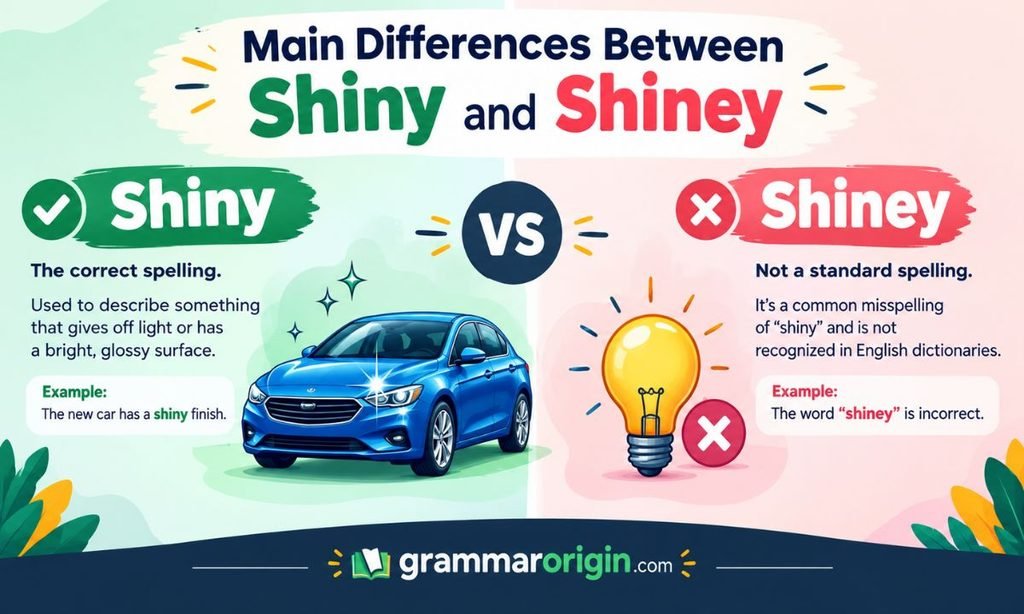
The core difference isn’t meaning. It’s correctness. “Shiny” is the grammatically correct form; “shiney” simply isn’t.
- Shiny appears in dictionaries, style guides, and formal writing
- Shiney only appears in typos and informal text
- Both are meant to express the same idea when someone writes “shiney”
- Only one of the two will pass a spellcheck or an editor’s review
Pronunciation and Etymology of Shiny
Shiny is pronounced “SHY-nee,” with the stress on the first syllable, and that sound is exactly why the “shiney” typo exists. The word traces back to “shine,” itself rooted in the Old English word “scinan,” meaning to give off light.
When English turns “shine” into an adjective, the silent “e” gets dropped before adding “-y.” That’s a standard rule for many verbs ending in “e,” similar to how “hope” becomes “hoping.”
So “shiney or shiny meaning” really comes down to the same idea either way. The meaning doesn’t change with the misspelling; only the correctness does. And no, there’s no separate “shiney pronunciation.” People just spell the same sound differently.
Also Read This Definition Quieter Vs More Quiet
Comparison Table
| Feature | Shiny | Shiney |
| Correctness | Correct | Incorrect |
| Dictionary status | Recognized | Not recognized |
| Common use | Formal and informal writing | Typos, casual text |
| Meaning | Bright, polished, reflective | No independent meaning |
Grammar Guide
Shiny follows a standard English rule: drop the final “e” from a base word before adding “-y.” Shine becomes shiny the same way some other short verbs shift into adjectives.
How each term is used in sentences
Shiny slots naturally into everyday descriptions.
- The counter looked shiny after a good scrub.
- She picked out a shiny red bike.
- His shoes were shiny enough to see your reflection in them.
“Shiney” never fits correctly, since it isn’t a recognized word at all.
Common mistakes learners make
Most learners add the extra “e” because they’re spelling by ear rather than by rule.
- Assuming the silent “e” in “shine” should carry over
- Matching the pattern of unrelated words like “honey” or “money”
- Trusting how a word sounds instead of checking a dictionary
Simple rules to remember
Here’s the short version: if the base word ends in a silent “e,” that “e” usually disappears before “-y” gets added.
- Shine to shiny drops the “e”
- Hope to hopeful, ride to riding follow a similar drop-the-e pattern
- When unsure, picture the base verb first, then apply the rule
Quick tips for writing and speaking
If you catch yourself about to type “shiney,” pause and swap in “shiny” instead.
- Read your sentence out loud before finalizing it
- Keep a mental list of similar tricky spellings
- Trust the dictionary over instinct when a word feels off
When to Use Each One
Use “shiny” any time you’re describing brightness, polish, or reflection, in both casual and formal writing. There’s no context where “shiney” is the right choice.
- A shiny car, a shiny coin, a shiny new idea: all correct
- Never write “shiney” intentionally, even in texts or social posts
When NOT to Use Each One
Never use “shiney” in essays, professional emails, resumes, or anything that gets graded or reviewed. It reads as a spelling error every time.
- Skip it in academic writing entirely
- Avoid it in business communication and marketing copy
- Even in a casual text, correcting it to “shiny” costs nothing and looks better
Shiny vs Shiney in UK and US English

Both American and British English agree on this one: “shiny” is correct everywhere, and “shiney or shiny UK” searches turn up the same answer as US English does. There’s no regional split here, unlike words such as “colour” versus “color.”
Dictionaries on both sides of the Atlantic list only “shiny.” So the spelling stays consistent no matter which English-speaking audience you’re writing for.
Which One to Use (Decision Guide)
If you’re describing something bright, glossy, or polished, choose “shiny” every time. If “shiney” ever crosses your mind, treat it as a signal to double-check your spelling.
- Reflective surface? Shiny.
- Bright new object or idea? Shiny.
- Ever a valid reason for “shiney”? No.
Real-World Practical Examples
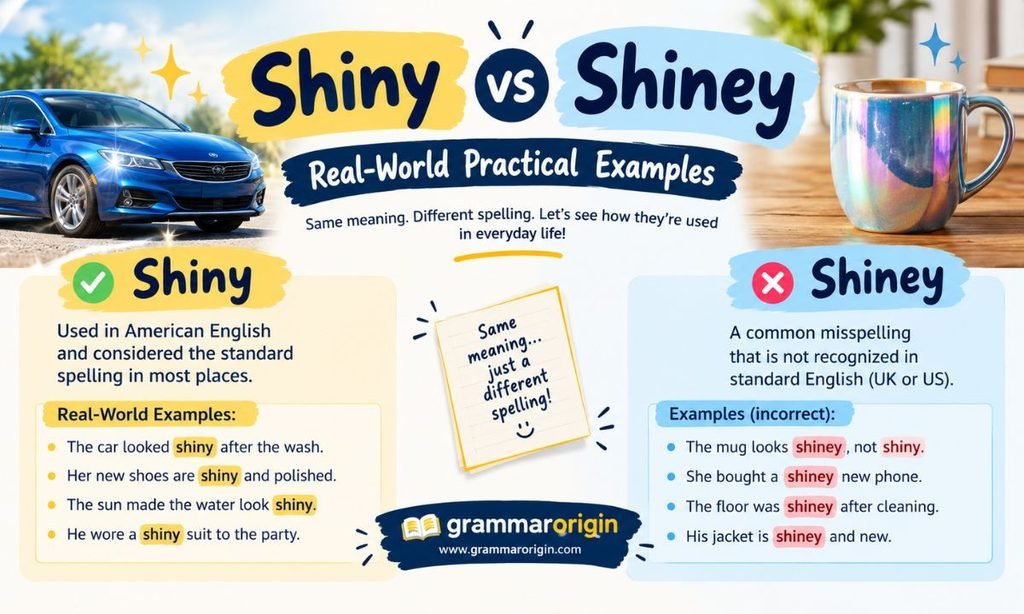
Seeing both forms side by side makes the correct choice obvious fast.
Shiny Examples
- The kitchen tiles looked shiny after mopping.
- She wore a shiny gold necklace to the event.
- His new laptop had a shiny aluminum finish.
- The lake looked shiny under the afternoon sun.
Shiney Examples
There aren’t any correct examples here, because “shiney” isn’t a standard English word. Any sentence using it should be corrected to “shiny.”
Other Uses of “Shiny” You Might Have Heard
“Shiny” pops up in a few pop-culture spots too, and none of them change the spelling rule. In the Pokémon games, a “shiny Pokemon” is a rare color-variant creature that players hunt for specifically because it stands out. There’s also a well-known song simply titled “Shiny,” from an animated film soundtrack, which uses the word in its usual bright, glittering sense.
As for “shiney name,” it does show up occasionally as a surname or stylized brand name, but that’s a proper noun choice, not a grammar exception. In regular writing, the adjective still stays “shiny.”
Also Read This Definition Quieter Vs More Quiet
Synonyms of Shiny
| Synonym | Best Used For |
| Glossy | Printed materials, magazine pages, painted surfaces |
| Gleaming | Clean, sparkling surfaces like glass or teeth |
| Polished | Metal, wood, or anything buffed to a shine |
| Lustrous | Hair, fabric, or pearls with a soft glow |
Self-Assessment (Fill in the Blanks)
- The floor looked ______ after mopping.
- “Shiney” is considered a ______ spelling.
- Her necklace was ______ and new.
- The correct spelling is ______, not shiney.
- The car’s paint looked ______ in the sun.
- “Shiney” doesn’t appear in any standard ______.
- His shoes were ______ after polishing.
- Students should avoid writing ______ in essays.
- The glass surface felt smooth and ______.
- The correct adjective form is ______.
Answers
- shiny
- incorrect
- shiny
- shiny
- shiny
- dictionary
- shiny
- shiney
- shiny
- shiny
Final Verdict
Shiny is the only correct spelling, and shiney has no standing in formal or informal English. Once you remember the “drop the e, add y” rule, the mistake stops happening on its own.
Summary
Shiny vs shiney really isn’t a close call. Shiny is the standard, dictionary-approved spelling, and shiney is simply an error that sounds plausible but isn’t valid.
Remember the rule behind it (shine loses its silent “e” before “-y” gets added) and you’ll never second-guess this one again.
Frequently Asked Questions
Which is correct, shiny or shiney?
Shiny is correct. Shiney is a common misspelling that doesn’t appear in any standard English dictionary, so it should always be replaced with shiny in writing.
Is “shiney” a word?
No, “shiney” isn’t a recognized word. It’s a spelling error that happens when people assume the silent “e” in “shine” carries over into the adjective form.
Is it shiny or shiney when describing something bright?
It’s always shiny, regardless of context. Whether you’re describing a surface, an object, or a figurative “shiny new idea,” shiny is the only valid spelling.
What does shiny mean?
Shiny describes something that reflects light and looks bright, smooth, or polished. It can apply to real objects like metal or glass, or figuratively to something new and appealing.
How do you pronounce shiny?
Shiny is pronounced “SHY-nee,” with emphasis on the first syllable. There’s no separate pronunciation for “shiney” since it isn’t a real, independently recognized word.
Why do people write shiney instead of shiny?
Most people write “shiney” because they’re spelling based on sound rather than rule. Since “shine” ends in a silent “e,” it feels natural to keep that letter when adding “-y,” even though standard spelling drops it.
Are there other well-known uses of the word shiny?
Yes. A “shiny Pokemon” refers to a rare color variant in the Pokémon games, and there’s a popular song called “Shiny” from an animated film. Both use the standard spelling, not “shiney.”

Muhammad Waqas is an English language teacher and grammar expert with over 8 years of experience helping students and professionals improve their writing skills. He specializes in English grammar, vocabulary, communication, and practical language learning. Through GrammarOrigin, Waqas shares clear, easy-to-understand content that helps readers write and speak English with confidence.