
Realy or really: if you’ve typed one and paused to double check it, you’re not the only one. This single missing letter is one of the most common typos in English, and it shows up in emails, texts, and even resumes.
The rule here is refreshingly simple once you see it laid out. This guide covers the meaning, the pronunciation, the history behind the double L, and the exact spots where writers slip up.
Realy or Really – Quick Answer
Really is correct. Realy is not a word in any dictionary, in any variety of English. When people search really vs realy, they’re usually just trying to confirm something they already suspect.
The mix-up happens because “really” sounds shorter than it looks when spoken quickly. Writers hear one L and type one L, but the correct spelling always keeps both.
Example: “I’m really tired today” is correct. “I’m realy tired today” is a spelling mistake, not a casual variant.
What Is “Realy”?
“Realy” isn’t slang, isn’t a regional spelling, and isn’t an accepted shortcut. So is realy a word at all? Not in any recognized sense; it’s simply a misspelling of “really” that’s dropped one letter.
It shows up constantly in fast typing and mobile messages, mostly because the brain matches spelling to sound rather than to the actual word structure. That doesn’t make it correct. It just makes it common.
Example: A text that reads “I realy want to go” gets understood fine, but it’s still spelled wrong, the same way “recieve” is a wrong version of “receive.”
What Is “Really”?
“Really” is an adverb built from the adjective “real” plus the ending “-ly.” It works as an intensifier, adding weight to a feeling, a statement, or a reaction. The really meaning, at its core, is about adding emphasis, truth, or degree to whatever comes next.
Writers use it to stress sincerity, show surprise, confirm something is true, or soften a negative statement. It sits among the most commonly used adverbs in everyday English, showing up in casual chats and formal writing alike.
Example: “I really appreciate this” emphasizes gratitude, while “Really? That’s surprising” expresses disbelief.
How to Pronounce “Realy” vs. How to Pronounce “Really”
There’s no really pronunciation guide worth learning for “realy,” because it isn’t a word. Only “really” has an actual sound pattern worth mastering.
British English Pronunciation of Really
British speakers typically pronounce it as three syllables: “REE-uh-lee.” The middle vowel gets a touch more space than it does in American speech.
Example: A British newsreader saying “It’s really quite remarkable” stretches that middle syllable a bit more than an American speaker would.
American English Pronunciation of Really
American English often compresses it into two syllables: “REE-lee.” That shortened sound is a big part of why the second L quietly disappears when people type in a hurry.
Example: Someone saying “I’m really busy” in a fast American accent often sounds like only two syllables, even though the spelling still has three.
Also Read This Todays or Today’s :Which One Is Correct
The Origin of “Really”
“Really” comes from Middle English, built the same way English still builds adverbs today: take an adjective, add “-ly.” Here, the adjective is “real,” which already ends in L.
Attach “-ly” to a word that ends in L, and a double L follows naturally. It’s the same pattern behind “fully,” “finally,” and “actually.” Nothing about “really” breaks that rule; it’s just easy to forget in the moment.
Example: Real plus ly equals really, the same way full plus ly equals fully.
British English vs. American English Spelling
Some English words split between British and American spelling, like “colour” and “color.” “Really” isn’t one of them.
Every major English-speaking region, British, American, Australian, and Canadian, spells it exactly the same way. There’s no regional excuse for dropping a letter here.
Example: A London magazine and a Los Angeles blog would both print “really excited,” never “realy excited.”
Which Spelling Should You Use?
Use really everywhere: essays, emails, texts, social captions, and professional documents. There’s no context where “realy” becomes acceptable, formal or otherwise.
Even in casual writing where people shorten words on purpose, like “rly” in texting, that gets understood as an abbreviation, not a stand-in spelling for “really.”
Example: A cover letter should always say “I’m really interested in this role,” never “realy interested.”
Common Mistakes with “Really”
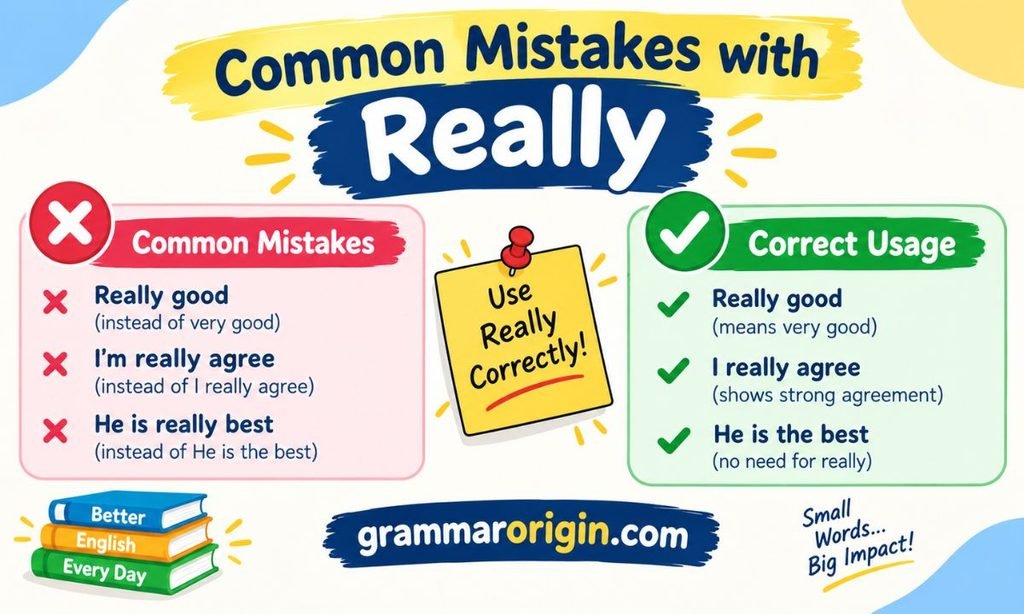
Beyond the missing letter, a couple of other slip-ups show up around this word too.
One is overusing “really” in formal writing, where stronger words like “genuinely” or “certainly” often read better. Another is word placement quietly changing meaning: “I really don’t know” reads as firm uncertainty, while “I don’t really know” reads a little softer.
Both Merriam-Webster and the Cambridge Dictionary list “really” as a standard adverb, and neither one carries an entry for “realy” under any spelling.
Example: “This report is really important” works fine casually, but “This report is genuinely significant” fits better in a formal memo.
Why Do People Misspell “Really” as “Realy”?
The biggest reason is sound. When “really” gets spoken quickly, the double L blends together, and the ear doesn’t register two separate L sounds. That’s how this really spelling mistake keeps repeating itself across generations of writers.
Fast typing and autocorrect gaps make it worse. Some spell-checkers let “realy” slide through because it can resemble a name or an unusual short word rather than getting flagged outright.
Example: Typing on a phone keyboard at speed, a writer might type “realy” without noticing, the same way “teh” sneaks in for “the.”
Is “Rly” or “Rlly” the Same as “Realy”?
No, these are different things entirely. “Rly” and “rlly” are informal texting abbreviations, openly understood as shorthand rather than attempts at correct spelling.
“Realy,” on the other hand, looks like someone tried to spell “really” properly and missed. That’s the real difference: one is intentional shorthand, the other is an accidental error.
Example: “rly?” in a text reads as casual slang, while “realy?” in an email reads as a typo.
How to Remember the Correct Spelling of “Really”
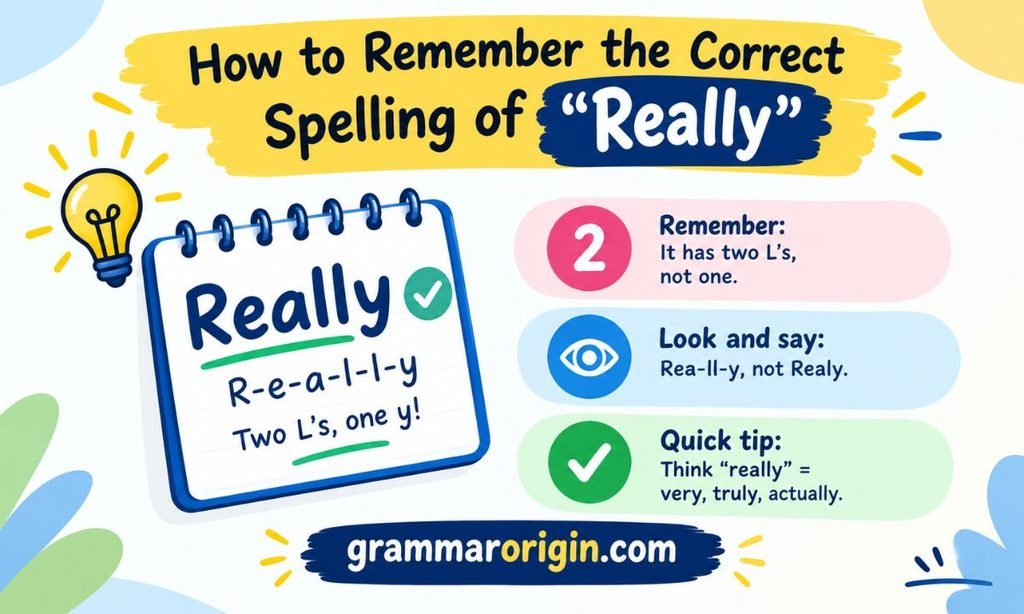
Wondering how to spell really without second-guessing yourself every time? The easiest trick is the formula itself: real plus ly equals really. The base word “real” already ends in L, and the “-ly” ending adds a second one.
Comparing it to similar words helps too. Think of “fully,” “chilly,” or “hilly,” where a word ending in L picks up another L from its ending.
Example: If you can spell “fully” correctly, you already know the pattern that makes “really” work the same way.
“Realy or Really” Synonyms
“Really” comes with plenty of really synonyms depending on tone, while “realy” has none, since it isn’t a real word to begin with.
For emphasis, writers often reach for “truly,” “genuinely,” or “certainly.” For surprise, “seriously” or “honestly” work well. For a more formal register, “indeed” or “in fact” can replace “really” cleanly.
Example: “I really enjoyed the show” can become “I genuinely enjoyed the show” in a more polished piece of writing.
“Really” in Everyday Examples
Seeing the word across different settings makes the correct spelling easier to lock in, especially once you notice how often the realy or really question comes up in ordinary writing.
Emails
“I’m really excited about this opportunity” reads as professional and clear. “I’m realy excited” undercuts that same message with a careless-looking typo.
News
Published journalism never prints “realy,” since editorial standards and spell-check systems catch it before publication. A typical line reads: “Officials say the plan really does move forward this quarter.”
Social Media
This is where “realy” shows up most, mostly because posts get typed fast and rarely get proofread. “This song is really catchy” still reads better than “This song is realy catchy,” even in a casual caption.
Formal Writing
In academic and business writing, “really” is grammatically fine, though stronger words sometimes fit better. “The results are really significant” can become “The results are genuinely significant” for a more formal tone.
Also Read This Todays or Today’s :Which One Is Correct
Realy or Really – Google Trends & Usage Data
Search interest in this exact comparison stays fairly steady, which reflects how often the double-L slip trips people up across different writing contexts.
Grammar tools like Grammarly consistently flag “realy” as an error, and non-native speakers from languages without double consonants are especially prone to dropping the extra letter.
Example: Running “I realy like this” through a grammar checker instantly returns a correction to “really.”
Comparison Table: Realy vs. Really
| Feature | Realy | Really |
| Correct spelling | No | Yes |
| Dictionary entry | None | Adverb meaning truly or very |
| Accepted in formal writing | No | Yes |
| Accepted in casual writing | No | Yes |
| British English | Not valid | Valid |
| American English | Not valid | Valid |
| Word origin | None (typo) | Real plus ly |
Realy or Really Synonym
When people search this exact phrase, they’re usually hunting for a word to replace “really” in a sentence, not asking about the misspelling itself.
Strong replacements include “truly,” “genuinely,” “certainly,” and “absolutely,” depending on how formal the writing needs to be.
Example: “That’s really impressive” becomes “That’s genuinely impressive” without losing any meaning.
Realy or Really Grammar
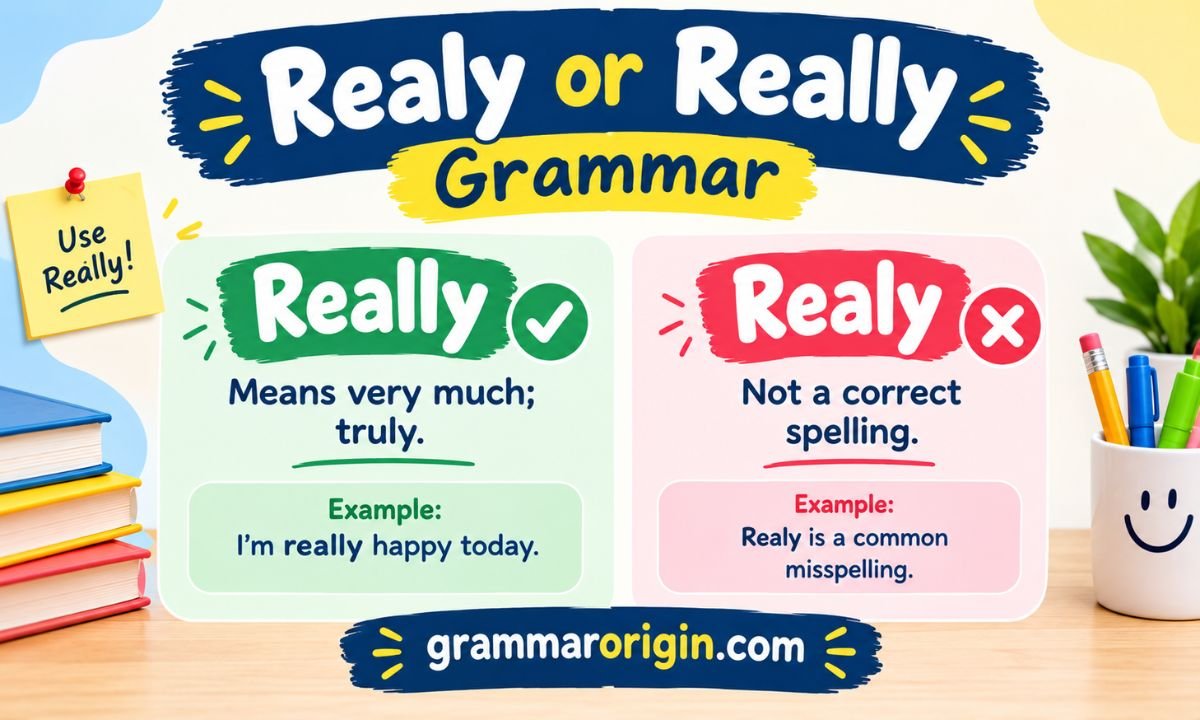
Grammatically, “really” functions as an adverb, most often modifying an adjective, a verb, or an entire statement. “Realy” has no grammatical function, since it isn’t recognized as a word at all.
Where “really” sits in a sentence can shift its meaning slightly, which is worth knowing once the spelling itself is settled.
Example: “She really likes the plan” emphasizes her enthusiasm, while “She likes the plan, really” adds a note of mild reassurance at the end.
Quick Self-Check
Try these before moving on. Cover the answers first if you want an honest test.
- “I’m ___ happy about this.” Answer: really
- Is “realy” ever correct in formal writing? Answer: no
- “rly” and “realy” mean the same thing. True or false? Answer: false
- Really comes from real plus what ending? Answer: -ly
- Does British English spell it differently from American English? Answer: no
If you got most of these right, the double-L rule has already stuck.
Frequently Asked Questions
Is realy or really the correct spelling?
Really is the correct spelling in every context. Realy is a common typo and isn’t recognized in any dictionary.
Is “realy” a real word?
No. It has no dictionary definition and no accepted use in formal or informal English.
Why does “realy” look almost right?
Because spoken English compresses the double L into a single sound, especially in fast American speech, which makes the shorter spelling feel natural even though it’s wrong.
Does British English spell it “realy”?
No. British, American, Australian, and Canadian English all use the exact same spelling: really.
What’s an easy way to remember the correct spelling?
Use the formula real plus ly equals really. Since “real” already ends in L, the “-ly” ending simply adds a second one.
Can “really” be replaced with another word?
Yes. Depending on tone, “truly,” “genuinely,” “certainly,” or “absolutely” all work as strong alternatives.
Will spell-check always catch “realy”?
Not always. Some checkers let it through because it can resemble an unusual name or short word, so a manual read-through still matters.
Final Thoughts
The choice between realy or really has exactly one answer: really is correct, and realy is a spelling mistake that happens to sound right when spoken quickly.
Once you remember that real already ends in L and “-ly” simply adds another, the double L stops feeling optional. Text a friend, write a report, or post online; really is the only spelling that belongs there.

Muhammad Waqas is an English language teacher and grammar expert with over 8 years of experience helping students and professionals improve their writing skills. He specializes in English grammar, vocabulary, communication, and practical language learning. Through GrammarOrigin, Waqas shares clear, easy-to-understand content that helps readers write and speak English with confidence.