
Vendor vs vender is a simple call: vendor is the correct spelling in nearly every modern context. Vender does exist, but dictionaries treat it as a rare variant, so it doesn’t belong in your contracts, emails, or resume.
This guide shows where each word comes from, what The New Yorker does differently, and how to choose in real writing. You’ll also see how a vendor compares with a seller, a supplier, and a vendee, with easy examples you can copy.
The Quick Answer: Vendor Is Correct (Almost Always)
In the vendor vs vender debate, use vendor. It’s the standard spelling in American and British English, and it’s the main entry in Merriam-Webster, which lists vender only as a “less common” variant.
The vendor meaning is simple: a person or business that sells goods or services. The vender meaning is exactly the same, so it’s a variant spelling, not a different word. Merriam-Webster’s vendor definition is a seller, with a second sense for a vending machine.
- Vendor vs vender in one line: choose vendor.
- Meaning of both words: someone who sells something.
- Status of vender: a less common variant spelling.
- Pronunciation: VEN-der.
For business emails, invoices, legal documents, school essays, and resumes, the vendor vs vender question has one answer: vendor. Vender is only worth using in two narrow cases: quoting an older text exactly, or following a house style that requires it.
Example: Please send the invoice to our payroll vendor.
Why Vendor and Vender Keep Getting Confused
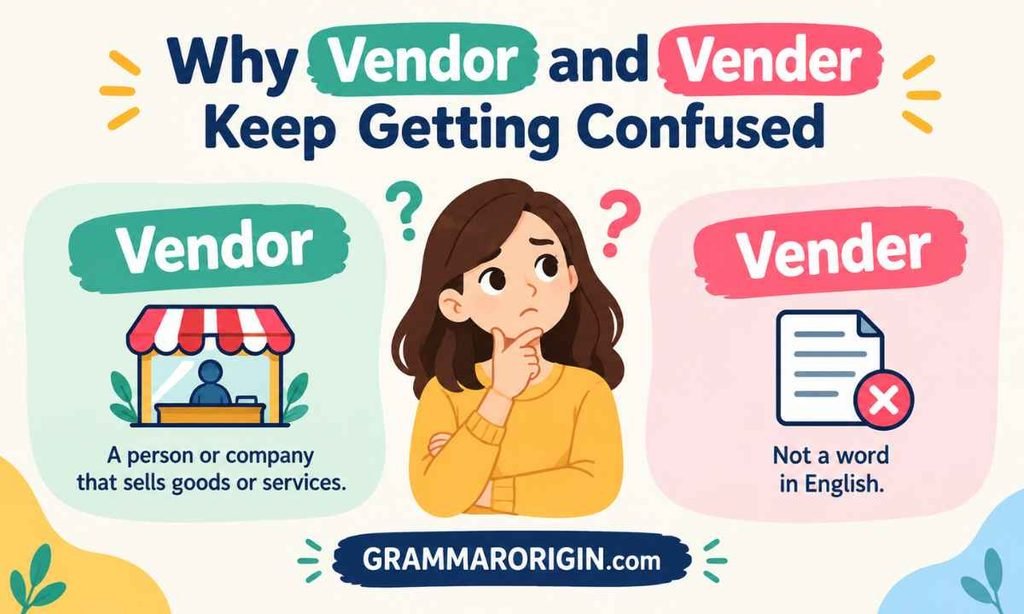
The vendor vs vender mix-up starts with sound, because the two words sound identical. In everyday speech the last syllable is a soft “der,” so your ear can’t tell -or from -er.
Spelling habits make it worse. English is full of agent nouns that end in -er, like baker, teacher, and seller, so “vend + er” feels logical. Spanish speakers also know vender as the verb for “to sell,” which adds another pull toward the -er spelling.
Example:
- Incorrect: We need to pay the vender by Friday.
- Correct: We need to pay the vendor by Friday.
Where the Word Vendor Actually Comes From
Vendor came into English from Anglo-French. It traces back to the Latin verb vendere, meaning “to sell.” Merriam-Webster links it to the Anglo-French forms vendur and vendour, built from vendre plus an agent ending.
The first known use in English is 1594, so the word is more than 400 years old. Etymonline also places it in the 1590s. It adds that vendere comes from a phrase meaning “to offer for sale.”
Example: The word vendor has been part of English since the 1590s.
Vender Isn’t a Typo, It’s a Genuine Historical Spelling
Vender is a real word, not a random slip. Etymonline records it in the 1590s as an agent noun. It was formed straight from the English verb “vend.”
So the vendor vs vender split began when two spellings arrived at almost the same time. Vendor followed the Anglo-French route, while vender followed the plain English route of adding -er.
Vendor won out, partly because it was more common in legal writing, as Etymonline points out. Business and law set the standard, and everyone else followed.
Some websites call vender archaic or obsolete. Dictionaries are gentler. Merriam-Webster simply lists it as a less common variant, so “variant spelling” is the safest label.
Example: A dictionary can call vender a variant without calling it a mistake.
The New Yorker’s Famous Exception
The New Yorker is widely reported to spell the word “vender” as part of its house style. That’s an editorial choice, and it doesn’t make vendor wrong.
The magazine is also known for the diaeresis in words like “coöperate” and “reëlect.” Its style prefers some older or unusual forms that most publishers dropped long ago.
If you write for that magazine, follow its style guide. If you don’t, there’s no reason to copy it, and the vendor vs vender choice stays simple. One magazine’s style doesn’t change what’s standard for everyone else.
Example: A New Yorker article might mention a hot dog vender, while almost every other outlet would print vendor.
Is Vender Ever Correct Today?
Rarely. In the vendor vs vender question, vender is acceptable only when you quote older text, follow a house style that requires it, or discuss the spelling itself.
| Situation | Spelling to use |
| Contracts, invoices, purchase orders | vendor |
| Resumes, cover letters, business emails | vendor |
| Blog posts, school work, marketing copy | vendor |
| Quoting an old text word for word | vender (only if that’s the original) |
| Writing for a publication whose style requires it | vender |
| A brand or person’s name spelled that way | Keep it as written |
Example: The old letter said, “The vender arrives at noon,” so the quote keeps the original spelling.
Why Getting This Right Actually Matters
Getting vendor vs vender right is a small habit with a real payoff. A wrong spelling makes your writing look careless, and in business it can cause real confusion. Standard terms keep records, searches, and contracts consistent.
Phrases like vendor management, vendor agreement, and third-party vendor are used across procurement and finance. A vendor contract, a vendor list, and a vendor portal all use the same standard spelling.
That’s why vendor or vender isn’t a harmless coin flip at work. If a team searches a system for “vendor,” a record typed as “vender” can slip through unnoticed.
It also affects first impressions. A hiring manager or client who spots a spelling slip in a short email may wonder what else was missed.
Example: Our vendor management policy is reviewed every year.
Also Read This Paster or Pastor: Which One Is Correct?
Vendor vs. Seller vs. Supplier vs. Vendee: What’s the Real Difference
Vendor and seller both mean the one who sells. A supplier usually provides goods or materials on an ongoing basis, and a vendee is the buyer.
| Word | Meaning | Where you’ll see it |
| Seller | Anyone who sells something | Everyday speech, online marketplaces |
| Vendor | A person or business that sells goods or services | Business, street vendor stalls, food vendors, software, events |
| Supplier | A business that regularly provides goods or materials | Manufacturing, retail supply chains |
| Vendee | The buyer in a sale | Law and property deals |
Companies use these labels a little differently, so check your own contract language when it matters.
Example:
- The seller listed the bike online.
- A food vendor set up outside the stadium.
- Our packaging supplier ships every Monday.
- The vendee signed the sale agreement.
Vendor vs Vendee in Law and Real Estate
In law, the vendor is the person who sells and the vendee is the person who buys, most often in property deals. Dictionary.com defines the legal sense of vendor as a person who sells something, especially real property.
Merriam-Webster’s legal entry gives vender as an accepted variant, but vendor is still the headline spelling. That’s the vendor vs vender pattern in legal writing too. In British property writing, “the vendor” simply means the home seller.
A simple memory trick: the -or ending is the one giving, and the -ee ending is the one receiving. Lessor and lessee follow the same pattern.
Example: The vendor accepted the offer, and the vendee arranged the mortgage.
Is Vendor vs. Vender a US vs. UK Spelling Difference?
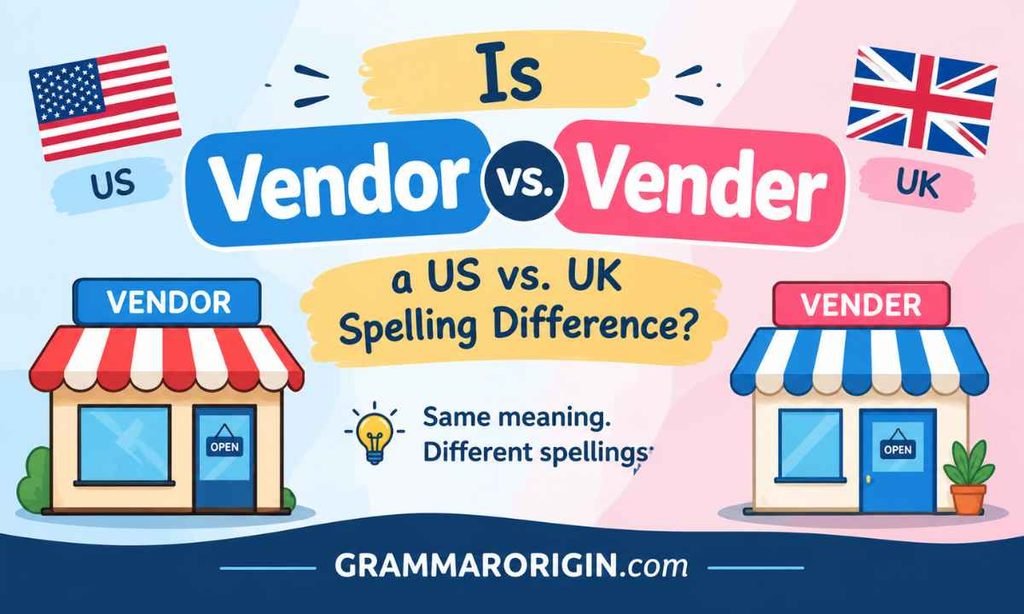
No. Both American and British English use vendor as the standard spelling, and vender is not the “British version.”
Some dictionaries do mark vender as a variant that shows up in American English, with entries reading “US also vender.” Modern English Usage says much the same.
Even so, the vendor spelling remains the dominant choice on both sides of the Atlantic.
So the vendor vs vender choice doesn’t depend on your audience. Pick vendor.
Example: Both the London agency and the Chicago firm hired a vendor for the event.
Vender in Spanish: Why It Means “To Sell”
In Spanish and Portuguese, vender is a verb that means “to sell.” English doesn’t use it that way.
Both languages inherited the word from Latin vendere. English kept “vend” as the verb and “vendor” as the noun, while Spanish kept “vender” as the verb and “vendedor” as the seller.
That’s why some English writers with a Spanish background type “vender” without noticing. It’s a quiet driver of the vendor vs vender confusion online.
Example:
- Spanish: Quiero vender mi casa.
- English: I want to sell my house, so I’ll contact the vendor.
Vendor vs. Vender in Real Sentences
In real writing, the vendor vs vender question answers itself: vendor appears everywhere, while vender appears only in quoted or house-style text. Seeing the word in context makes the pattern easier to remember.
Example sentences with vendor:
- The software vendor offers free updates for two years.
- A street vendor sold roasted corn near the bus stop.
- We compared three vendors before signing the contract.
- The vendor’s invoice arrived late.
- The home vendor accepted the highest bid.
Example of vender in quoted text:
- The magazine described “a fruit vender on the corner,” keeping its own house spelling.
Vendor Word Forms
Vendor is a noun, and its plural is vendors. The related verb is “vend,” which gives vends, vended, and vending. A vending machine is sometimes called a vendor too, which is a second sense in Merriam-Webster and Dictionary.com.
| Form | Word | Example |
| Noun (singular) | vendor | The vendor called back. |
| Noun (plural) | vendors | Several vendors joined the fair. |
| Possessive (singular) | vendor’s | The vendor’s stall was busy. |
| Possessive (plural) | vendors’ | The vendors’ prices matched. |
| Verb (base) | vend | They vend snacks at the gate. |
| Verb (-ing form) | vending | A vending machine stood nearby. |
Example: The vendors’ association meets every second Tuesday.
How to Pronounce Vendor and Vender
Both words are usually said “VEN-der,” with the stress on the first syllable. Merriam-Webster also notes a second pronunciation of vendor, “ven-DOR,” with stress on the second syllable.
In IPA terms, that’s /ˈvɛndər/ for the common sound. Because vendor vs vender sounds the same out loud, your ears can’t help you, and you have to rely on memory.
Example: Say “ven-der” aloud, then write vendor with an “o.”
The Bigger Pattern: Other -or vs. -er Word Mix-Ups
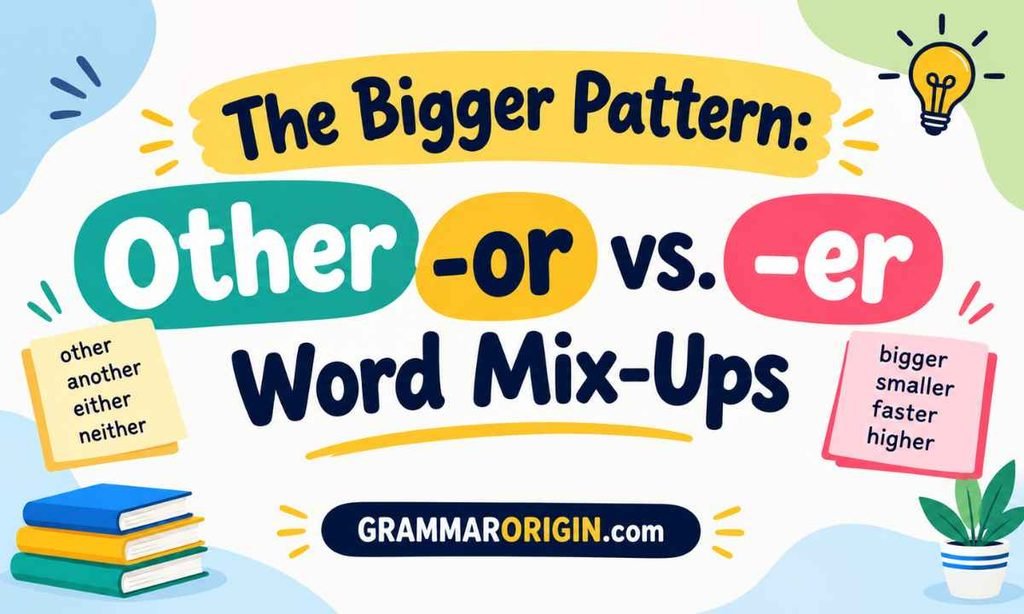
Vendor vs vender is just one of many -or and -er pairs that sound alike, which is why so many writers mix them up. As a loose guide, formal and legal words from Latin often take -or, while everyday English agent nouns usually take -er.
Legal pairs show this clearly: vendor and vendee, lessor and lessee, donor and donee. Everyday words like baker, teacher, and seller take -er.
Some words accept both forms, such as advisor and adviser. When you’re unsure, check a current dictionary instead of trusting the sound. For vendor or vender, the dictionary answer is the -or spelling.
Example:
- The lessor rented the flat to a new tenant.
- The baker opened early.
- Her adviser (or advisor) read the draft.
Quick Recap: Vendor vs. Vender
- Vendor is the standard spelling in modern American and British English.
- Vender is a genuine but rare variant from the 1590s, not a random typo.
- The New Yorker uses vender as part of its house style.
- In law, the vendor sells and the vendee buys.
- Vender means “to sell” in Spanish, which explains many mix-ups.
- Whenever you wonder about vendor or vender, choose vendor unless you’re quoting or following a style that says otherwise.
Example: Our event vendor confirmed the booking.
Vendor vs vender oxford dictionary
On vendor vs vender, Oxford-style entries list vendor as the headword and treat vender as a US variant. The entry text reads “vendor (US also vender),” and it defines the word as a person or company offering something for sale.
The same entry adds a legal sense: the seller in a sale, especially of property. That matches how vendor is used in contracts and real estate. For the exact current wording, check the live Oxford entry online.
Example: According to the entry, a vendor is a person or company offering something for sale.
Also Read This Paster or Pastor: Which One Is Correct?
Vender or vendor new yorker
People search “vender or vendor New Yorker” because they spotted vender in the magazine and assumed it was a mistake. It isn’t, because the magazine uses that spelling on purpose.
It fits the same house style that gives us “coöperate.” That doesn’t turn vender into the general standard. Outside that magazine, vendor is still the spelling readers expect.
Example: A writer for another outlet should still write vendor, even after reading vender in The New Yorker.
Vendor vs supplier
A vendor sells to you, while a supplier provides the goods or materials you need to make or run something. The two overlap, so many teams use them almost interchangeably.
Procurement teams sometimes split them. A software company or a market stall owner is usually called a vendor. A business that ships raw materials or parts on a schedule is usually called a supplier.
Example: The cafe’s coffee supplier delivers beans weekly, and its till system vendor handles software updates.
Summary
Vendor vs vender comes down to one rule: write vendor. It’s the standard spelling in the US and the UK, in business, law, and everyday writing.
Vender is a real but rare variant, mostly seen in quoted text, house styles like The New Yorker’s, and Spanish. Keep vendor in your own writing and you won’t go wrong.
Frequently Asked Questions
Which one is correct, vendor or vender?
For vendor vs vender, vendor is correct in almost every modern context. Vender is a rare variant that mostly appears in quoted text or in publications with a house style that prefers it.
What does “vender” mean?
In English, vender is a rare variant spelling of vendor, meaning someone who sells something. In Spanish, vender is a verb meaning “to sell.”
What’s the difference between a vendor and a vender?
There’s no difference in meaning. The only difference is spelling and usage: vendor is the standard form, while vender is a less common variant.
What is the difference between a vendor and a seller?
A seller is anyone who sells something. A vendor usually suggests a business, a stall, or a service provider that sells in a commercial setting.
Is vender a verb?
No. In English the verb is “vend,” and vender is a rare noun spelling. Using vender as a verb is a mistake, though in Spanish it’s a normal verb.
Is vendor vs vender a US vs UK spelling difference?
No. Both American and British English prefer vendor. Some dictionaries mention vender as a US variant, but vendor is still the standard on both sides.

Muhammad Waqas is an English language teacher and grammar expert with over 8 years of experience helping students and professionals improve their writing skills. He specializes in English grammar, vocabulary, communication, and practical language learning. Through GrammarOrigin, Waqas shares clear, easy-to-understand content that helps readers write and speak English with confidence.