
Wondering how to spell business correctly? You’re not alone — it’s one of the most commonly misspelled words in English, often written as “buisness,” “bussiness,” or “busines” instead.
The confusion happens because the word is pronounced “bizz-ness,” but spelled with a U before the I. Once you know why, the mistake is easy to fix.
This guide gives you the correct spelling, what business actually means, and a simple memory trick to lock it in for good — plus real examples so you can use it confidently every time.
Quick Answer: Business or Buisness?
“Business” is the correct spelling. Not “buisness,” not “bussiness,” and not “busines.”
The word has one U before the I, one S in the middle, and a double S at the end: b-u-s-i-n-e-s-s.
If you’ve ever typed “buisness” without thinking twice, you’re not alone — it’s one of the most commonly misspelled words in English.
Why Business Is Hard to Spell
Business is hard to spell because it isn’t pronounced the way it’s written.
You say it as “bizz-ness” — but you write it with a U right after the B. That mismatch is where most people slip up.
The word actually comes from “busy.” Once “-ness” was added, the pronunciation changed over time, but the spelling kept the original U. So your ear expects one thing, and the correct spelling gives you another.
Knowing this one fact fixes the confusion for good.
How to Pronounce Business (IPA)
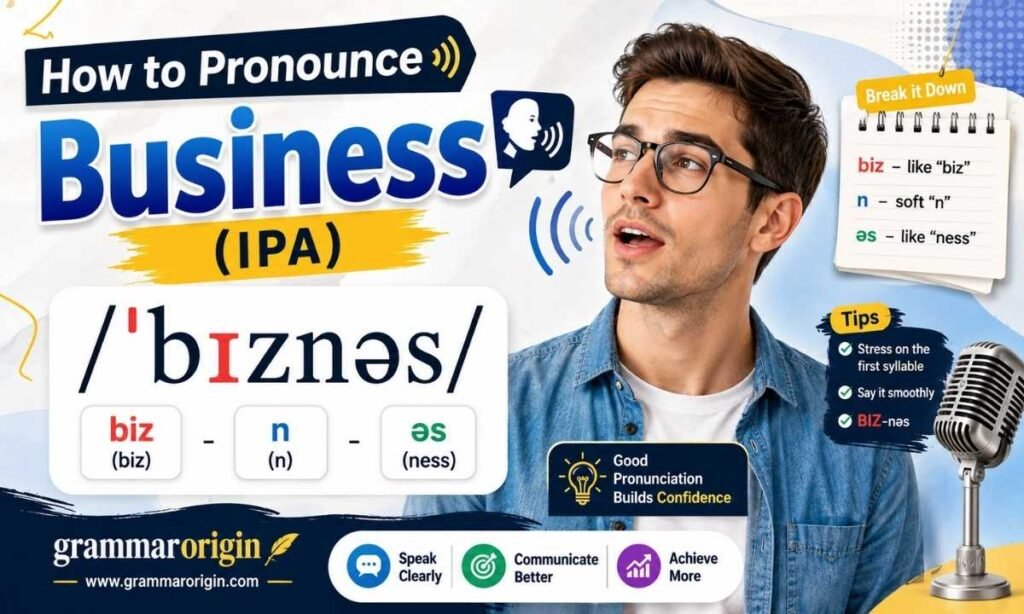
Business is pronounced /ˈbɪznɪs/ — “BIZ-nis.”
Say it slowly and you’ll notice something: there’s no clear “oo” or long “u” sound anywhere in it, even though the spelling starts with B-U-S.
This is exactly why the mistake happens. Your ear hears “biz,” so your brain reaches for an I first — giving you the wrong order, “buis-.”
Remembering the spelling as BUS + I + NESS, rather than sounding it out, is the more reliable approach.
Business Spelling Breakdown
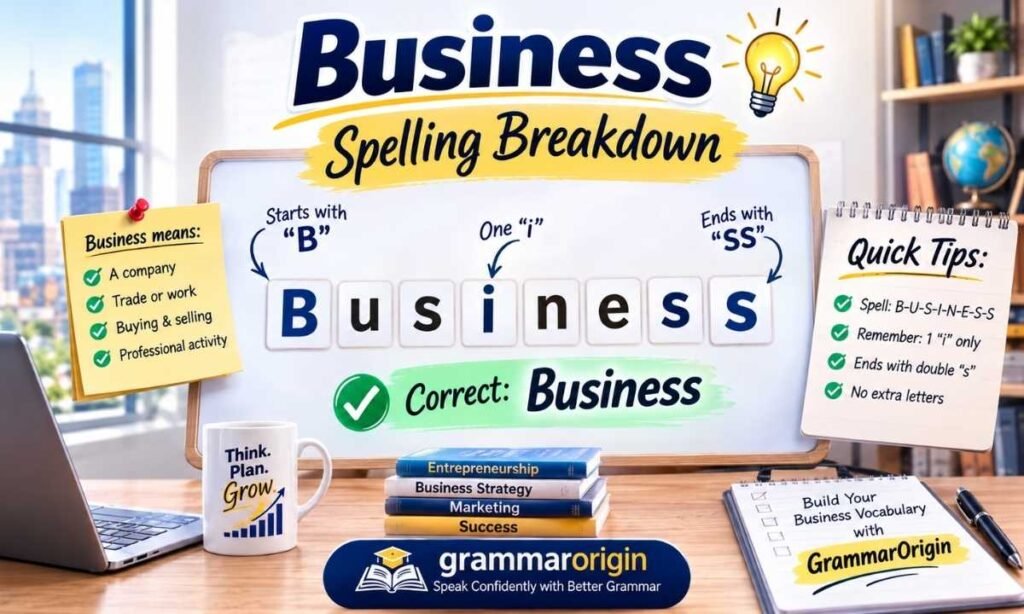
Break the word into three simple parts: BUS + I + NESS.
- BUS — always B-U-S, like the vehicle
- I — comes right after BUS
- NESS — the same ending as “happiness” or “fitness”
Put together, that’s 8 letters: B-U-S-I-N-E-S-S.
The BUS part is your anchor. It’s never B-I-S or B-U-I-S — always B-U-S, in that order.
Word Origin
Business comes from Old English, where it started as “bisignes” — meaning care, occupation, or concern.
Over time, this became “busyness” in Middle English, still tied closely to the word “busy.”
The meaning gradually shifted from personal concern or anxiety to commercial activity, which is how we use “business” today — trade, work, or a company.
The spelling held on to its original U, even after the pronunciation changed.
Also Read This 22th or 22nd The Correct Spelling
Memory Trick for Business
Here’s a simple way to lock in the spelling:
“A bus always comes first — B-U-S, then I, then NESS.”
Picture a bus pulling up before anything else happens. That’s your reminder: BUS comes first, in the correct U-before-I order.
Once BUS is set, just add I (the passenger) and NESS (the destination): BUS + I + NESS = business.
Next time you hesitate, ask yourself: does a bus start with U or I? Always U
Common Misspellings of Business (with reasons)
Here are the most common ways people get it wrong — and exactly why each one happens.
- Buisness ❌ — Swaps the U and I. This is the most common mistake, caused by sounding the word out phonetically.
- Bussiness ❌ — Doubles the S after “bu.” Writers often confuse it with words like “fussiness.”
- Busines ❌ — Drops one S from the ending. Business ends in a double S, just like “witness” and “fitness.”
- Bussines ❌ — Combines two mistakes at once: doubled middle S plus a dropped ending S.
Correct spelling: business — one U before I, one S in the middle, double S at the end.
British vs American Spelling

There’s no difference. “Business” is spelled the same way in British, American, Australian, and Canadian English.
Unlike words such as “colour/color” or “organise/organize,” business doesn’t change across English variants. One spelling works everywhere — in emails, resumes, and formal writing, no matter your audience.
What Business Means
Business refers to work, trade, or a commercial enterprise — or an organization that sells goods and services.
It also has everyday, non-commercial uses:
- Trade sense: “She started a small business selling candles.”
- Work sense: “I have some business to finish before the meeting.”
- Personal sense: “What he does at home is his own business.”
The spelling stays the same no matter which meaning you’re using.
Also Read This 22th or 22nd The Correct Spelling
Idioms & Common Phrases with Business
Business shows up in several everyday English phrases beyond its literal meaning:
- Mind your own business — stop asking about something private
- Get down to business — stop chatting and start the real work
- None of your business — a private matter that doesn’t concern you
- Business as usual — things continuing normally, despite disruption
- Take care of business — handle what needs to be done
Same spelling applies across every one of these — the idiom never changes the word itself.
Related Words
A few words share the same root or spelling pattern as business, so learning them together helps:
- Busy — the root word business comes from
- Busyness — the state of being busy or occupied (not “business,” a different word with a similar spelling)
- Businessman / Businesswoman — a person who works in business; same B-U-S-I-N-E-S-S spelling, just with the role added
- Businesslike — behaving in a serious, efficient, professional manner
Note the difference: busyness (state of being busy) and business (trade/work) are two separate words that are easy to mix up.
Frequently Asked Questions
How do you spell business?
Business is spelled B-U-S-I-N-E-S-S. The most common mistake is writing “buisness” (swapping the U and I), but the correct order always starts with BUS.
Is it “business” or “buisness”?
It’s business. “Buisness” is a common typo caused by sounding the word out — but the correct spelling keeps U before I, not the other way around.
How do you pronounce business?
Business is pronounced /ˈbɪznɪs/, or “BIZ-nis.” This is exactly why people misspell it — the pronunciation doesn’t match the U-I order in the spelling.
How do you spell businessman?
Businessman is spelled the same way as business, with “man” added at the end: B-U-S-I-N-E-S-S-M-A-N. The same rule applies to businesswoman and businesslike.
How do you spell the plural form, businesses?
It’s businesses, with “-es” added. Words ending in -s, like business, take “-es” in the plural instead of just “-s.”
How should you spell business in professional documents?
Always use the standard spelling, business — never “buisness” or “bussiness.” Misspelling it in resumes, emails, or reports can make writing look careless and hurt credibility.
conclusion
Business is spelled B-U-S-I-N-E-S-S — one U before the I, single S in the middle, double S at the end. The mistake usually happens because the pronunciation doesn’t match the spelling, not because the rule is complicated.
Remember it with BUS + I + NESS, and you won’t second-guess it again. Whether you’re writing an email, a resume, or a report, you can now spell business correctly, every time

Muhammad Waqas is an English language teacher and grammar expert with over 8 years of experience helping students and professionals improve their writing skills. He specializes in English grammar, vocabulary, communication, and practical language learning. Through GrammarOrigin, Waqas shares clear, easy-to-understand content that helps readers write and speak English with confidence.