
Wondering whether it’s 22th or 22nd? You’re not alone — this is one of the most common ordinal number mix-ups in English. The confusion happens because most numbers end in “th,” so it feels natural to assume 22 should too.
In this guide, you’ll get the correct spelling, the simple rule behind it, real examples for dates and birthdays, and the common mistakes to avoid — so you never second-guess it again.
22th or 22nd – Quick Answer

22nd is the correct spelling. 22th is not a recognized ordinal number in English.
Every ordinal number takes its suffix from the last digit of the number. Since 22 ends in 2, it follows the same pattern as “second” — hence 22nd.
Examples:
- The event is on March 22nd.
- This is her 22nd birthday.
- He finished 22nd in the race.
“22th” should never appear in writing, whether casual or formal.
Easy Rule for Ordinal Numbers
The suffix depends only on the last digit of the number, not the whole number itself.
| Last Digit | Suffix | Example |
| 1 | -st | 21st, 31st |
| 2 | -nd | 22nd, 32nd |
| 3 | -rd | 23rd, 33rd |
| 0, 4–9 | -th | 20th, 24th, 29th |
One exception breaks this pattern: numbers ending in 11, 12, and 13 always use -th, regardless of their last digit. That’s why it’s 11th, 12th, and 13th — not 11st, 12nd, or 13rd.
This exception is also why 22 does not become “22th.” Twenty-two is not in the 11–13 range, so the normal last-digit rule applies, and the suffix stays “-nd.”
The Origin of 22th or 22nd
Ordinal suffixes trace back to Old English, where the words for “first,” “second,” and “third” developed separately from the rest of the number system. Most other ordinals were built by simply adding “-th” to the cardinal number (four → fourth, six → sixth).
“Second” never went through that shift. It kept its own irregular form, and that form is where “-nd” comes from. Every number ending in 2 — 2nd, 22nd, 32nd, 102nd — inherits this same irregular ending, because grammatically each one is still built on “second.”
This is also why the confusion with “22th” is so common. English learners correctly notice that most ordinals end in “-th,” then over-apply that rule to numbers that are historically exceptions. The mistake isn’t random — it’s a natural pattern-matching error based on how the majority of ordinals actually work.
Linguists classify 1st, 2nd, and 3rd as suppletive forms — meaning they don’t follow the regular derivation rule of the rest of the number system. Once a number ends in one of these three digits (except 11, 12, 13), it inherits the suppletive ending instead of “-th.”
Also Read This Spelling Bee Words
British English vs American English Spelling

There is no regional spelling difference here. Both British and American English use 22nd — never 22th.
The only real difference between the two dialects is date order, not spelling:
| Region | Date Format | Example |
| American English | Month Day, Year | June 22nd, 2026 |
| British English | Day Month Year | 22nd June 2026 |
So whether the day comes first or last in the sentence, the number itself is always written as 22nd in both varieties of English.
Style Guide Rules: APA, MLA, Chicago & AP
Read more related click Me
Major style guides agree that “22nd” is the only correct ordinal form, but they differ on when to use numerals versus spelled-out words.
AP Style (used by most news publications) generally spells out ordinal numbers first through ninth in text (first, second, ninth), and uses figures from 10th onward. Under this rule, 22nd is correctly written as a numeral, not “twenty-second.”
Chicago Manual of Style takes a more conservative approach for formal prose, often spelling out ordinal numbers up to one hundred in narrative writing, though numerals are standard for dates.
APA Style, used mainly in academic and scientific writing, generally uses numerals for numbers 10 and above, which again makes “22nd” the expected form.
MLA Style follows a similar numeral-based approach for numbers above nine, particularly in dates and measurements.
The practical takeaway: across every major style guide, dates use the numeral form — 22nd — regardless of which system a document follows. The numeral-vs-spelled-out debate matters more for standalone numbers in narrative sentences than it does for dates.
How to Pronounce 22nd
“22nd” is pronounced the same as “twenty-second” — twen-tee-SEK-und.
Break it down:
- Twen-tee (twenty)
- Second (pronounced normally, as in “second place”)
There’s no separate pronunciation for the numeral form versus the spelled-out form — they sound identical. The written suffix “-nd” is silent when spoken; it exists only to signal the ordinal meaning in text, not to change how the number sounds.
A quick way to check pronunciation: say the full word “twenty-second” out loud first, then use that same sound whenever reading “22nd” written in numeral form.
22nd in Formal Documents vs Casual Writing
22nd is correct in every register — formal, academic, business, and casual. The spelling itself never changes based on context.
What does change is whether to use the numeral or spell out the word:
- Legal and official documents (contracts, certificates, government forms) often spell out ordinal numbers in full — “twenty-second” — to prevent misreading or alteration, especially in dates tied to signatures or deadlines.
- Business emails and reports typically use the numeral form — 22nd — since it’s faster to read and universally understood.
- Academic writing generally follows the numeral convention above nine, per most style guides, so 22nd is standard.
- Casual writing (texts, social media, invitations) always uses the numeral — 22nd is the natural, expected form here.
So the spelling “22nd” itself is never in question. The only real decision in formal writing is numeral versus fully spelled-out word — and that decision depends on the specific document type, not on grammar correctness.
Common Mistakes with 22th or 22nd
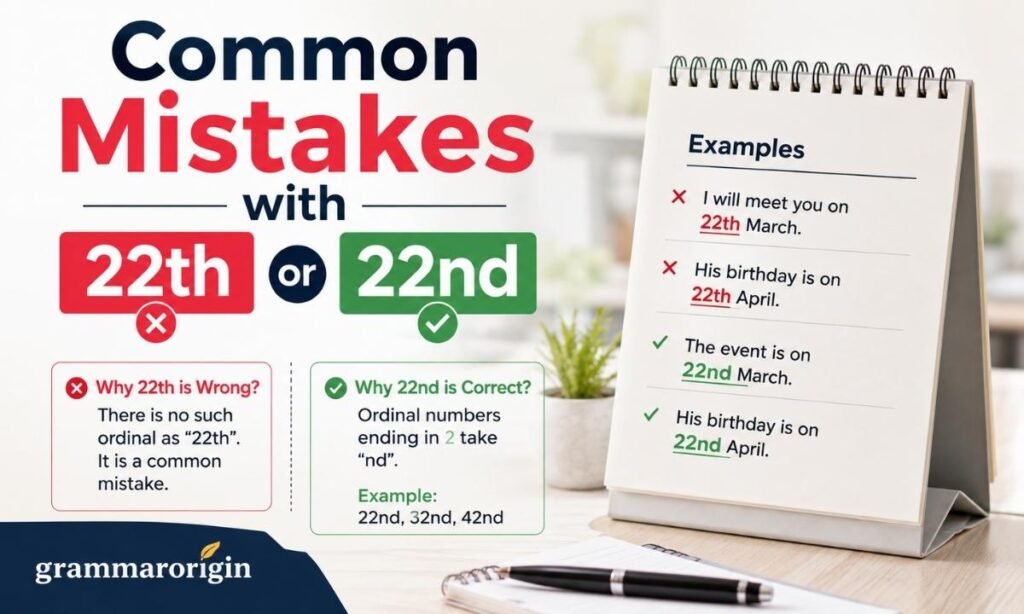
The most common mistake is writing “22th” instead of 22nd. This happens because writers over-apply the “-th” rule that covers most other numbers.
Mistake 1: Overusing “-th”
Since 4th, 5th, and 10th all end in “-th,” it feels natural to assume 22 follows the same pattern. It doesn’t, because 22 ends in 2.
Mistake 2: Confusing 12th with 22nd
Some writers assume 12th and 22nd should match since both end near “2.” But 12 is part of the 11–13 exception group, while 22 is not.
Also Read This Spelling Bee Words
Mistake 3: Inconsistent Usage in the Same Document
Writing “22nd” in one paragraph and “22th” elsewhere is a common proofreading slip, especially in long documents with repeated dates.
Quick fix: Whenever the number ends in 2 (and isn’t 12), the suffix is always “-nd.”
22nd in Dates: Month-wise Examples
The rule for writing 22nd stays exactly the same, no matter which month it appears in.
| Month | Example |
| January | January 22nd |
| February | February 22nd |
| March | March 22nd |
| April | April 22nd |
| May | May 22nd |
| June | June 22nd |
| July | July 22nd |
| August | August 22nd |
| September | September 22nd |
| October | October 22nd |
| November | November 22nd |
| December | December 22nd |
The month never changes the ordinal suffix. Whether it’s “February 22nd” or “December 22nd,” the number 22 always takes “-nd.”
British vs American Order
American style places the month first: June 22nd. British style places the day first: 22nd June. Either way, the spelling of the number itself doesn’t change.
22nd Birthday – Meaning & Correct Usage
What “22nd Birthday” Means
A 22nd birthday marks the day someone turns 22 years old. It’s the twenty-second time their birthday has occurred.
Is It “Happy 22nd Birthday” or “Happy 22th Birthday”?
“Happy 22nd Birthday” is correct. “Happy 22th Birthday” is a common but incorrect version, since 22 always takes the “-nd” suffix.
This mistake shows up often on cards, cakes, and social media captions, where people write quickly and skip the ordinal rule. The correct phrase to use in any greeting, caption, or card is always “22nd Birthday.”
Happy 22nd Birthday Wishes
Short Wishes
- Happy 22nd birthday! Here’s to another year of great memories.
- Wishing a very happy 22nd birthday to someone amazing.
- Cheers to 22! Happy birthday.
Funny Wishes
- Happy 22nd birthday — officially too old for excuses, still young enough for adventures.
- 22 looks good on you. Try not to peak too early.
- Welcome to 22, where the birthday cake outshines the responsibilities.
Heartfelt Wishes
- Happy 22nd birthday. May this year bring the same joy you’ve brought to everyone around you.
- Twenty-two years of growth, laughter, and unforgettable moments — happy birthday.
- Here’s to celebrating you today and every day. Happy 22nd birthday.
Comparison Table: 22th vs 22nd
| Feature | 22nd | 22th |
| Grammatically correct | Yes | No |
| Accepted in dictionaries | Yes | No |
| Used in formal writing | Yes | No |
| Used in casual writing | Yes | No |
| Recommended usage | Always | Never |
The comparison is simple: 22nd is correct in every context, and 22th has no valid use in English.
Full Ordinal Number Reference Chart (1st–31st)
| Number | Ordinal | Number | Ordinal |
| 1 | 1st | 17 | 17th |
| 2 | 2nd | 18 | 18th |
| 3 | 3rd | 19 | 19th |
| 4 | 4th | 20 | 20th |
| 5 | 5th | 21 | 21st |
| 6 | 6th | 22 | 22nd |
| 7 | 7th | 23 | 23rd |
| 8 | 8th | 24 | 24th |
| 9 | 9th | 25 | 25th |
| 10 | 10th | 26 | 26th |
| 11 | 11th | 27 | 27th |
| 12 | 12th | 28 | 28th |
| 13 | 13th | 29 | 29th |
| 14 | 14th | 30 | 30th |
| 15 | 15th | 31 | 31st |
| 16 | 16th |
This chart covers every date in a month, so it works as a quick lookup for any ordinal number, not just 22nd.
Memory Trick to Remember 22nd
Picture a runner crossing the finish line in 2nd place. Since 22 ends in the same digit as 2, it takes the same ending.
2nd → 22nd → 32nd → 42nd
Every time a number ends in 2 (except 12), think of that runner in second place, and the “-nd” ending will come naturally.
Frequently asked questions
1. Is it 22th or 22nd?
22nd is correct. 22th is not a valid ordinal number in English.
2. Why is 22nd correct instead of 22th?
Ordinal suffixes depend on the last digit of a number. Since 22 ends in 2, it takes the “-nd” suffix, just like the word “second.”
3. How do you write 22nd in a sentence?
Use it directly before or after a date, event, or position — for example, “Her birthday is on the 22nd of June” or “He finished 22nd in the race.”
4. Is 22nd used the same way in British and American English?
Yes. Both use 22nd. The only difference is date order — American style writes “June 22nd,” while British style writes “22nd June.”
5. Is it “Happy 22nd Birthday” or “Happy 22th Birthday”?
“Happy 22nd Birthday” is correct. “Happy 22th Birthday” is a common mistake and should be avoided.
6. How do you pronounce 22nd?
It’s pronounced “twenty-second,” the same as the spelled-out word. The written “-nd” is silent when spoken.
7. Should 22nd be spelled out in formal documents?
It depends on the document. Legal and official papers sometimes spell out numbers in full to avoid errors, while business and academic writing typically use the numeral form, 22nd.
8. What are other numbers that use the “-nd” suffix like 22nd?
Any number ending in 2, except 12, uses “-nd.” Examples include 2nd, 32nd, 42nd, and 52nd.
Final Thoughts
The debate between 22th or 22nd has one clear answer: 22nd is correct, and 22th has no place in proper English. The rule is simple — numbers ending in 2 take the “-nd” suffix, the same way “second” does.
Whether it’s a date, a birthday, or a formal document, this rule never changes. Keep this guide handy, share a happy 22nd birthday wish with someone celebrating, and the “22th” mistake never has to happen again.

Muhammad Waqas is an English language teacher and grammar expert with over 8 years of experience helping students and professionals improve their writing skills. He specializes in English grammar, vocabulary, communication, and practical language learning. Through GrammarOrigin, Waqas shares clear, easy-to-understand content that helps readers write and speak English with confidence.