
Trying to figure out which spelling bee words to study can feel overwhelming — school lists, grade levels, and difficulty tiers all blur together. Whether you’re prepping for a classroom bee or a national-level competition, starting with the wrong words wastes valuable practice time.
This guide organizes spelling bee words by both grade level and difficulty, so you can jump straight to the list that matches where you are. You’ll also find guidance on how bee tiers work and what makes certain words genuinely harder to spell.
Spelling Bee Words by Grade
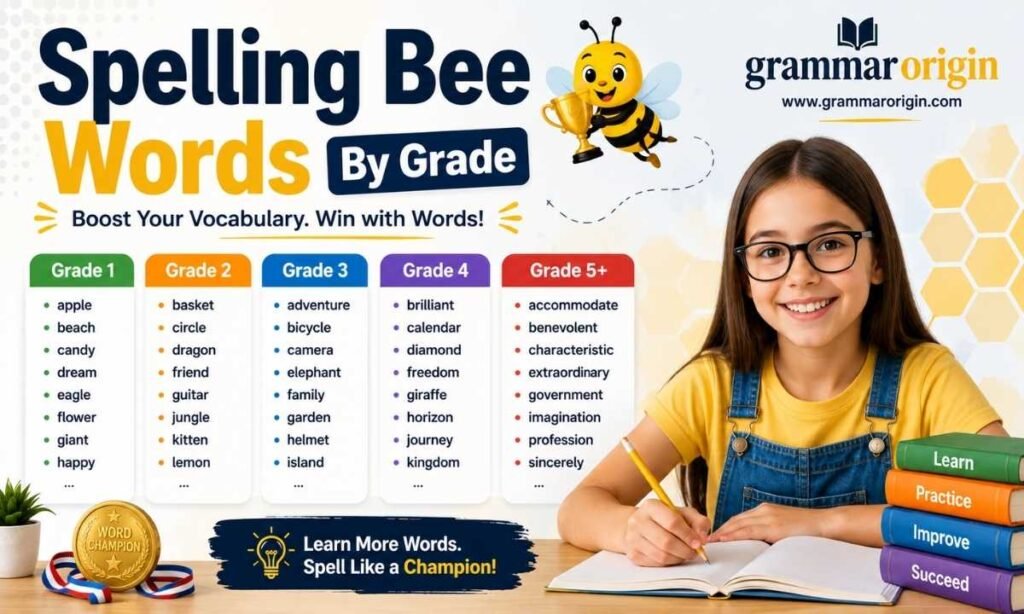
Spelling bee words get harder as grade level increases, moving from short, familiar words to multi-syllable words with tricky patterns. Below is a working list for each grade band, based on common classroom and school-level word difficulty.
Grade 1–2 Spelling Bee Words
At this level, words are short and follow regular spelling patterns. The goal is building confidence, not tripping kids up.
Common examples: cat, sun, frog, happy, garden, purple, kitten, yellow, sister, monkey.
Most words have one or two syllables. Sight words and simple vowel patterns dominate this stage.
Grade 3–4 Spelling Bee Words
By grade 3–4, students meet silent letters, double consonants, and early prefixes and suffixes.
Common examples: believe, ceiling, kitchen, quarter, written, careful, powerful, doubt, wrist, knowledge.
These words test whether a child can hear a sound and still get the spelling right, since many don’t follow simple phonics rules.
Grade 5–6 Spelling Bee Words
This tier introduces Greek and Latin roots, along with words that are commonly misspelled even by adults.
Common examples: necessary, occurrence, embarrass, accommodate, conscience, telephone, biography, patience, sequence, exaggerate.
Double consonants and root-based spelling patterns start appearing more often here.
Grade 7–8 Spelling Bee Words
At grade 7–8, spelling bee words pull from classical vocabulary and French or Latin borrowings.
Common examples: entrepreneur, questionnaire, phenomenon, bureaucracy, surveillance, philosophy, archaeology, rendezvous, connoisseur, silhouette.
Students at this level are usually preparing for regional or state-level competitions, so the vocabulary gets noticeably harder.
Grade 9–12 Spelling Bee Words
High school-level spelling bee words are close to championship difficulty, drawing from a wide range of language origins.
Common examples: conscientious, miscellaneous, idiosyncratic, prestidigitation, ubiquitous, mellifluous, chrysanthemum, sycophant, onomatopoeia, tergiversation.
Knowing word origins matters more than memorization at this stage, since many of these words follow predictable patterns from Greek or Latin roots.
Spelling Bee Words by Difficulty
READ MORE REALTED POST CLICK ME
Not sure which grade list fits your level? Difficulty tiers work as a shortcut, whether you’re a beginner or prepping for nationals.
Easy Spelling Bee Words
Easy spelling bee words are short, familiar, and follow regular spelling rules. They’re a good starting point for first-time competitors.
Examples: pencil, spider, blanket, market, circle, winter, castle, flower, thunder, cotton.
Medium Spelling Bee Words
Medium-difficulty words include irregular spellings and common words people often get wrong.
Examples: separate, library, February, government, vegetable, business, Wednesday, tomorrow, neighbor, foreign.
These words look simple but hide small traps, like unexpected vowels or silent letters.
Hard Spelling Bee Words
Hard spelling bee words reliably eliminate competitors at regional and district bees.
Examples: fluorescent, bureaucracy, questionnaire, Mediterranean, surveillance, exaggerate, phenomenon, silhouette, entrepreneur, lieutenant.
Most come from French or Greek origin, with endings and letter combinations that don’t match how they sound.
Championship-Level Spelling Bee Words
Championship words are the ones that show up in state and national final rounds.
Examples: onomatopoeia, ubiquitous, prestidigitation, sesquipedalian, mellifluous, idiosyncratic, tergiversation, autochthonous, perspicacious, chrysanthemum.
At this level, knowing the language a word comes from is often the only way to spell it correctly on the first try.
Spelling Bee Tiers Explained (Classroom to National)
Spelling bee difficulty depends on competition tier, not just grade level. A student can face very different word lists depending on which stage they’re competing in.
| Tier | Who Competes | Word Difficulty |
| Classroom | Single class | Easy, grade-appropriate words |
| School | Whole school | Easy to medium words |
| District/County | Multiple schools | Medium to hard words |
| Regional | Multiple districts | Hard words |
| State | Top spellers statewide | Hard to championship words |
| National (Scripps) | Top state spellers | Championship-level words |
A student’s actual spelling level often outpaces their school grade once they reach district or regional competition. That’s why difficulty tier matters more than age when choosing a word list to study.
Hard Spelling Bee Words — With Etymology
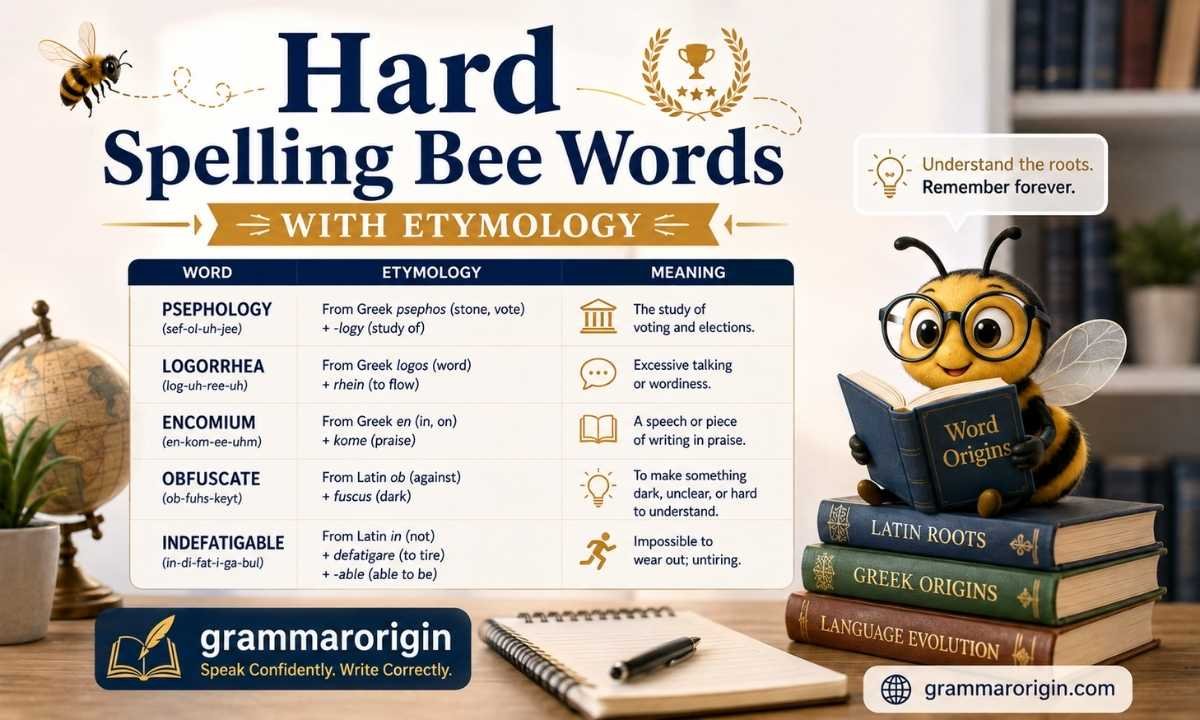
Knowing where a word comes from often explains its spelling better than memorization does. Once you know a root, you can guess new words built from it.
chrysanthemum (Greek) — from khrysos (gold) and anthemon (flower). The name refers to the flower’s original golden color.
silhouette (French) — named after Étienne de Silhouette, an 18th-century French finance minister known for cutting costs. His name became linked to cheap outline portraits, and later to the art form itself.
bureaucracy (French + Greek) — combines French bureau (desk, office) with Greek kratos (rule, power). Literally, “rule by the desk.”
conscientious (Latin) — from con- (together) and scire (to know), forming conscientia, meaning shared or inner knowledge.
questionnaire (French) — built from Latin quaestio (inquiry) through French questionner, with the -aire suffix marking it as a tool or instrument.
Mediterranean (Latin) — from medius (middle) and terra (earth). The Romans used it to describe the sea at the center of their known world.
surveillance (French) — from sur- (over) and veiller (to watch), meaning to watch from above.
psychology (Greek) — from psyche (mind, soul) and logos (study). Psyche also meant “butterfly” in Greek mythology, a symbol tied to the soul.
metamorphosis (Greek) — from meta (change) and morphe (shape), meaning a change of form.
onomatopoeia (Greek) — from onoma (name) and poiein (to make). It describes words that imitate the sound they represent, like buzz or crack.
The pattern holds across most hard spelling bee words: Greek roots tend to show up in science and abstract concepts, French roots often carry silent letters and unusual endings, and Latin roots build the backbone of everyday academic vocabulary. Learning even a dozen common roots covers hundreds of words you’ll never have to memorize individually.
Adult Spelling Bee Words

Adult spelling bees show up at workplace fundraisers, pub quiz nights, and charity events. The words chosen for these are usually different from school-level lists — they’re picked to be entertaining to watch, not just difficult.
Common adult bee words: perspicacious, pulchritudinous, ephemeral, sycophant, ubiquitous, mellifluous, labyrinthine, meretricious, acquiescence, magniloquent.
Workplace and pub-quiz style bees also lean on french-origin professional vocabulary: entrepreneur, connoisseur, lieutenant, etiquette, liaison, rendezvous, bureaucracy.
These words work well for adult audiences because they’re recognizable once spelled correctly, even if most people couldn’t spell them cold. That mix of familiarity and difficulty is what makes adult bees fun rather than frustrating.
If you’re organizing one, mixing a few “everyday but tricky” words (like definitely or separate) with showstoppers keeps the competition balanced instead of eliminating everyone in round one.
How Spelling Bee Competitions Work
How does a spelling bee actually work? A pronouncer reads a word aloud, the speller can ask for its definition, origin, or use in a sentence, and then they spell it out loud, letter by letter, without writing it down.
Here’s the typical format:
Spellers take turns, usually in a set order. Getting a word wrong means elimination in most formats, though some classroom bees use a “second chance” or team-based system instead.
Spellers are allowed to ask questions before spelling. Common ones include the word’s definition, its language of origin, alternate pronunciations, and a sentence using it in context. This isn’t cheating — it’s a normal, expected part of competition.
If two spellers make it to the final round and neither misspells, some competitions use a pre-set list of tiebreaker words. Others declare co-champions, depending on the rules set by the organizer.
Spelling is checked against a specific dictionary, almost always Merriam-Webster for U.S. competitions. This matters because some words have more than one accepted spelling, and only the dictionary’s primary spelling usually counts.
For a home or classroom bee, keeping this format — ask questions, then spell aloud, no writing allowed — makes practice sessions feel closer to the real thing.
Official Scripps List vs. This Practice List
Is this the official Scripps spelling bee word list? No. This is a practice list built to match the patterns and difficulty of real competitions, not the official document Scripps publishes.
The Scripps National Spelling Bee releases its own study material each year, called the School Spelling Bee Study List. It contains roughly 4,000 words divided into difficulty tiers, and it’s distributed directly to participating schools through official channels.
This page’s words are organized the same way real bees test spellers — by grade and by difficulty — but they aren’t pulled from a private or paywalled Scripps document. They’re compiled to reflect the vocabulary patterns typically seen at each competition level.
If you’re registered for an official Scripps competition, your school coordinator can give you access to the real study list. Use this page to build a foundation and understand difficulty patterns — then switch to the official list once you know exactly which competition you’re entering.
Frequently Asked Questions
What are spelling bee words?
Spelling bee words are words chosen from a standard dictionary, usually Merriam-Webster, to test spelling ability in a competition. They range from simple classroom-level words to rare championship words, and are typically grouped by grade or difficulty.
How can I practice spelling bee words?
The best way is to hear a word spoken aloud, then spell it from memory without looking at it written down. Reading a list isn’t enough — real bees test listening and recall, not visual memory. Practicing with a parent, teacher, or a spelling app that reads words aloud matches the actual competition format best.
How do I memorize difficult spelling bee words?
Learning word origins works better than pure memorization. Once you know that tele- means “far” or -eur is a common French ending, you can spell unfamiliar words that share those roots. Pair each hard word with its language of origin and root meaning instead of just repeating the spelling.
What are the hardest spelling bee words?
The hardest words usually come from Greek, French, or Latin origins where the spelling doesn’t match the sound. Words like chrysanthemum, onomatopoeia, and prestidigitation have appeared at national-level competitions and consistently trip up experienced spellers.
Can you ask for a word’s definition or a sentence during a spelling bee?
Yes. Spellers are allowed to ask the pronouncer for the word’s definition, language of origin, alternate pronunciations, and a sentence using it before spelling. This is a standard, expected part of competition, not a penalty or a shortcut.
What happens if there’s a tie in a spelling bee?
Most competitions use a pre-set list of tiebreaker words when two spellers reach the final round without a miss. Some smaller or classroom-level bees choose to declare co-champions instead, depending on the organizer’s rules.
How many words should I study for a spelling bee?
For a classroom bee, 50–100 words is usually enough. School and district bees call for 200–500 words. Spellers preparing for regional, state, or national competitions often study several thousand words, along with root patterns to cover words they haven’t seen before.
Are British spellings accepted in spelling bee competitions?
No, not usually. Most U.S. spelling bees, including Scripps, judge spelling against Merriam-Webster, which uses American spelling conventions. British spellings like colour or organise are typically marked incorrect unless the competition specifically states otherwise.
Final Thoughts
Spelling bee words don’t have to feel random or overwhelming once you know how they’re organized. Whether you’re studying by grade, by difficulty, or working through championship-level words, the pattern is always the same: word origin explains spelling better than memory alone.
Start with the list that matches your current level, then move up as words start feeling easier. Etymology-based practice, combined with hearing words spoken aloud rather than just reading them, is what separates confident spellers from spellers who freeze on stage.
Use this page as your starting point, then check with your school or Scripps directly once you know exactly which competition you’re entering. The right preparation, not just a long word list, is what actually gets you further in a spelling bee.

Muhammad Waqas is an English language teacher and grammar expert with over 8 years of experience helping students and professionals improve their writing skills. He specializes in English grammar, vocabulary, communication, and practical language learning. Through GrammarOrigin, Waqas shares clear, easy-to-understand content that helps readers write and speak English with confidence.