
Appreciate it or appreciated it? If you’ve ever paused mid-email wondering which one sounds right, you’re not alone. The two phrases look almost identical but sit in different tenses, and picking the wrong one can make a message feel slightly off.
The short answer: use appreciate it when your gratitude is happening right now, and appreciated it when you’re talking about something in the past. This guide walks through both forms, the mistakes people make, and exactly how to choose correctly every time.
What Is the Difference Between “Appreciate It” and “Appreciated It”?
The core difference is verb tense. Appreciate it is present tense, and appreciated it is simple past tense.
Example: “I appreciate it” (right now) versus “I appreciated it” (back then, when it happened).
| Phrase | Tense | Meaning |
| Appreciate It | Present | Gratitude felt right now |
| Appreciated It | Past | Gratitude felt at an earlier time |
Understanding “Appreciate It”
Appreciate it means your thanks are current, happening in this exact moment.
Example: “Thanks for grabbing my coffee order. I appreciate it.”
A few more everyday uses:
- I appreciate it when you double-check my work.
- Thanks for waiting. I appreciate it.
- I appreciate your patience with this delay.
Each of these puts the gratitude in the present, tied to something that just happened or is happening.
Understanding “Appreciated It”
Appreciated it describes gratitude that existed at a specific point in the past, not now.
Example: “I appreciated your advice when I was starting my first job.”
A few more examples:
- We appreciated the extra help during last year’s move.
- She appreciated the flexibility her manager showed during finals week.
- He appreciated the warm welcome when he joined the team in 2023.
Notice how each sentence anchors to a past moment rather than the present.
Why People Confuse These Two Phrases
The appreciate it or appreciated it mix-up happens because writers often add “-ed” out of habit, assuming it sounds more polished, without checking whether the timing actually calls for past tense.
Example: Someone might write “I appreciated your help” right after receiving that help, simply out of reflex, even though the gratitude is happening now.
Common Mistake
Incorrect: “Thanks for the quick reply. I appreciated it.”
Correct: “Thanks for the quick reply. I appreciate it.”
Since the reply just arrived, the gratitude belongs in the present.
Another Common Error
Incorrect: “I appreciate your support last month.”
Correct: “I appreciated your support last month.”
Here the event is already finished, so the past tense fits.
Why Context Matters
Picking the right phrase always comes down to one question: is this feeling happening now, or did it happen before?
Example: “I appreciate it” fits a text you’re sending seconds after a favor. “I appreciated it” fits a story you’re telling about something from weeks ago.
“I Appreciate It” vs “I Appreciate You”
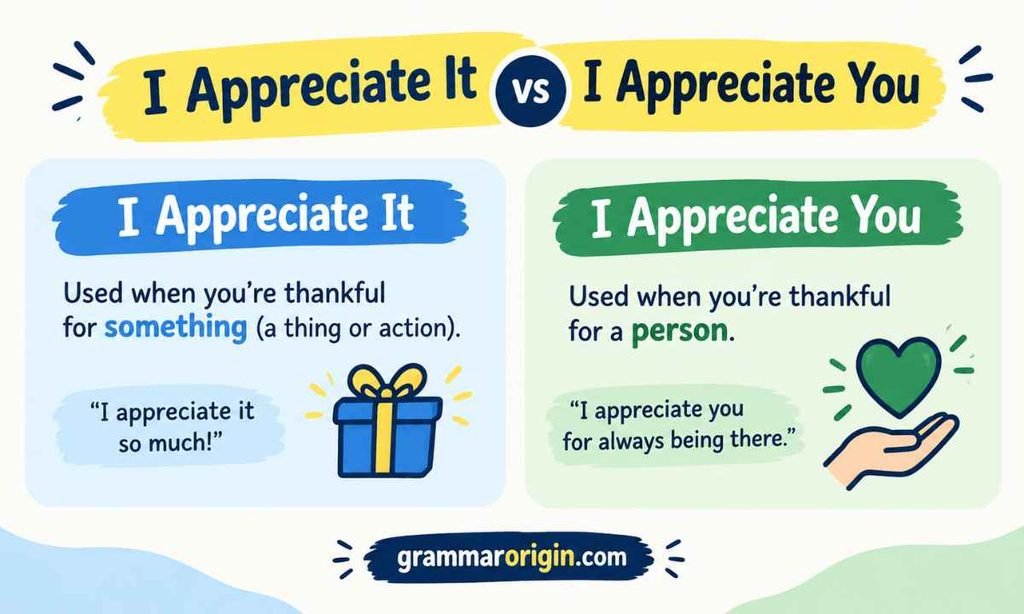
These two phrases don’t mean exactly the same thing. Appreciate it thanks someone for an action, while appreciate you thanks the person themselves.
Example: “I appreciate it” points at the favor. “I appreciate you” points at the person who did it.
- Appreciate it: “Thanks for covering my shift. I appreciate it.” (thanking the action)
- Appreciate you: “You always show up for me. I appreciate you.” (thanking the person)
Both are grammatically fine, but they carry a different weight. “Appreciate you” feels more personal, since it recognizes someone’s character rather than a single task.
“Would Appreciate It” and “Would Have Appreciated It”
Use would appreciate it to make a polite request about something that hasn’t happened yet, and would have appreciated it to describe a wish about something that already happened.
Example: “I would appreciate it if you could send that file today.”
More examples of “would appreciate it” as a polite ask:
- I would appreciate it if you arrived a few minutes early.
- We would appreciate it if you kept this confidential.
And “would have appreciated it,” used for a past wish that didn’t come true:
- I would have appreciated it if she had called ahead.
- They would have appreciated it if the team had given more notice.
This conditional form shows up constantly in professional emails, since it softens a request without sounding demanding.
When to Use “I Appreciate It”
Reach for appreciate it any time you’re thanking someone in the moment, whether that’s out loud or in writing.
Example: “Thanks for holding the elevator. I appreciate it.”
In Daily Conversations
Casual, spoken thanks almost always land in present tense.
- Thanks for the ride. I appreciate it.
- Thanks for listening. I appreciate it.
- Thanks for being patient with me today.
In Professional Emails
Business writing leans on this phrase because it reads as polite without sounding stiff.
Example: “Thank you for reviewing the proposal. I appreciate it.”
In Customer Service
Companies use this phrasing constantly to acknowledge a customer’s cooperation.
- We appreciate your feedback.
- We appreciate your patience while we sort this out.
- We appreciate your continued business.
Why It Sounds Natural
Native speakers tend to favor short, direct phrasing, and “I appreciate it” delivers gratitude cleanly without extra words getting in the way.
When to Use “I Appreciated It”
Reach for appreciated it when you’re describing gratitude tied to a moment that’s already passed.
Example: “I appreciated the extra guidance during my first project.”
Referring to Past Experiences
- I appreciated your mentorship during that rough first year.
- We appreciated the opportunity to pitch directly to the board.
- He appreciated the second chance his coach gave him.
In Storytelling
When you’re recounting something that already happened, past tense keeps the timeline consistent.
Example: “During my internship, I appreciated every bit of feedback I got, even the harsh notes.”
In Reflections and Reviews
- Looking back, I appreciated how patient my professor was.
- They appreciated the flexibility the company offered during a hard year.
Why It Fits Historical Contexts
This phrase signals that the appreciation belongs to a chapter that’s already closed, which is exactly what makes it useful in memoirs, reviews, and reflective writing.
Also Read This Commit vs Comit: Correct Spelling, Meaning & Examples (2026)
Real-Life Case Study: How One Job Applicant Avoided a Costly Grammar Mistake
Jordan, a recent graduate, had just wrapped up a second-round interview and wanted to send a same-day thank-you email. Her first draft read: “Thank you for meeting with me today. I appreciated it.”
Example: The interview had ended less than an hour earlier, so the gratitude was still current, not something from the past.
A friend reviewing the draft pointed out the tense issue, and Jordan changed the line to: “Thank you for meeting with me today. I appreciate it.” The email went out sounding sharper and more natural.
Jordan didn’t land the job purely because of one verb tense, but hiring managers do notice small details like this, and a clean, well-timed message adds to a strong first impression.
Grammar Rule Behind “Appreciate It or Appreciated It”
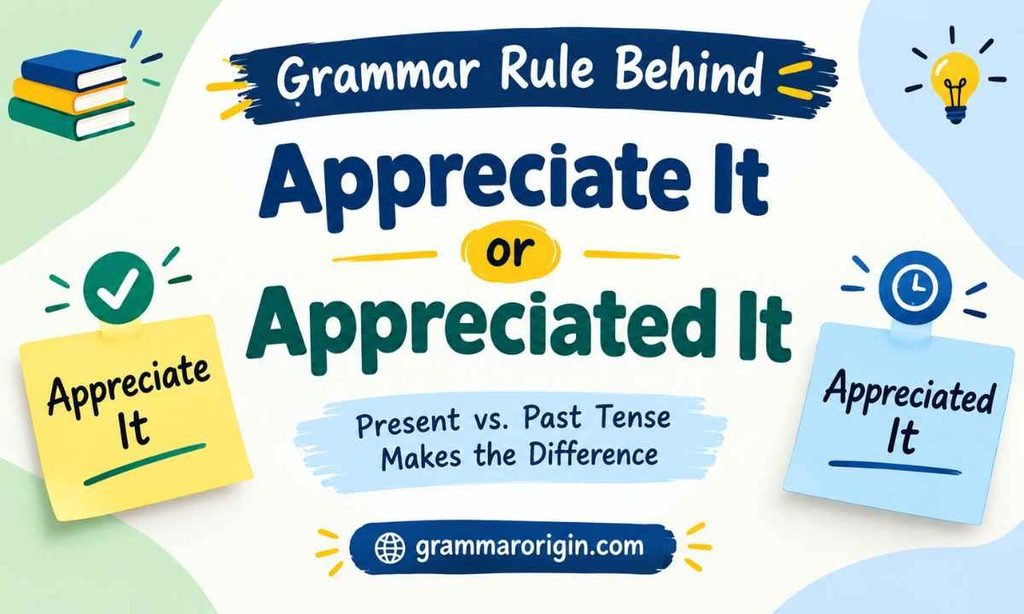
The basic rule is simple: match the verb tense to when the feeling actually exists.
Example: “I appreciate your help” (today) versus “I appreciated your help” (back in March).
Present Tense Rule
Use appreciate it when the action is happening now, the feeling is current, and there’s no time gap between the event and your thanks.
- I appreciate your effort on this.
- I appreciate your honesty.
- I appreciate your quick turnaround.
Past Tense Rule
Use appreciated it when the appreciation belongs to a finished event or an earlier stretch of time.
- I appreciated your patience during onboarding.
- We appreciated the extra staff during the holiday rush.
- She appreciated the warning before the meeting started.
Quick Memory Trick
Keep this short pairing in mind: now means appreciate it, then means appreciated it. That single line clears up almost every mix-up.
Data and Statistics: Why Proper Grammar Still Matters in 2025–2026
Written communication is still one of the most closely watched skills in hiring and workplace settings heading into 2026.
Example: A recruiter scanning two nearly identical follow-up emails is more likely to remember the one with cleaner, more natural phrasing.
Cambridge Dictionary lists appreciate as a transitive verb, meaning it needs a direct object such as “it,” “your help,” or “your time” to form a complete sentence. That grammar rule is exactly why “appreciate it” and “appreciated it” both keep the word “it” in place rather than dropping it.
- Clear, well-timed phrasing supports a stronger professional image.
- Small tense errors rarely block understanding, but they can make the reader pause for a second.
- Consistent grammar signals attention to detail, especially in emails, resumes, and client-facing writing.
Step-by-Step Guide: How to Choose the Correct Phrase Every Time
Before sending a message, run through this short sequence to land on the right phrase.
Example: For “Thanks for the update, I ___ it,” each step below leads you straight to “appreciate.”
Step 1: Identify the Time Frame
Ask whether the gratitude is happening now or happened earlier.
Step 2: Look for Time Indicators
- Present indicators: today, right now, currently
- Past indicators: yesterday, last year, previously, during college
Step 3: Match the Verb Tense
Present situations pair with appreciate. Past situations pair with appreciated.
Step 4: Read the Sentence Aloud
Saying the sentence out loud often reveals which tense sounds natural almost instantly.
Step 5: Double-Check Context
Reread the full sentence once more to confirm the verb matches the timeline you’re actually describing.
Common Alternatives to “I Appreciate It”
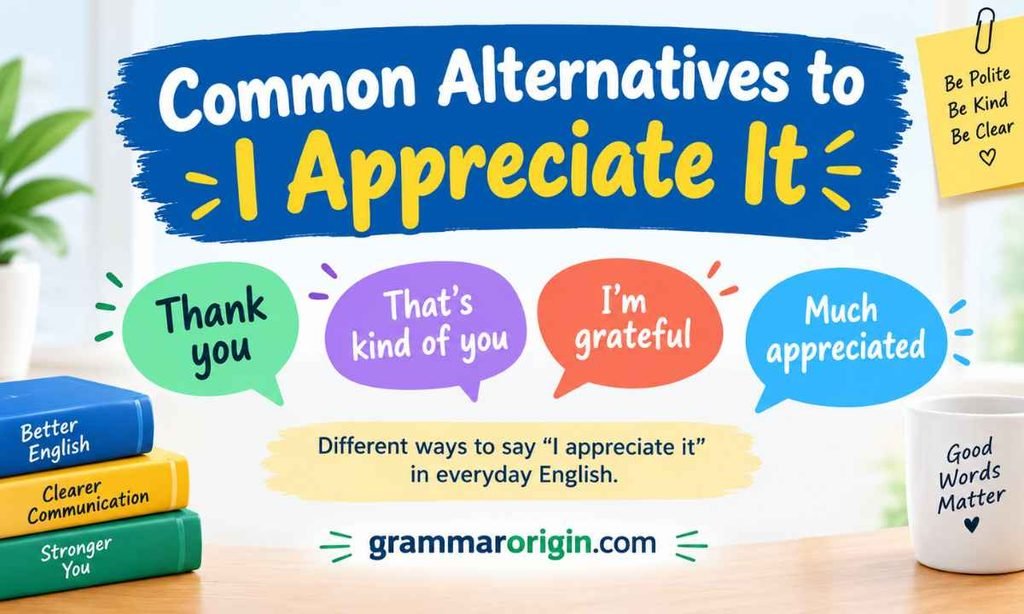
Sometimes a little variety keeps your writing from sounding repetitive, especially when you want to match a more formal register.
Example: “Thanks so much, this really means a lot.”
Professional Alternatives
- Thank you for your assistance.
- I sincerely appreciate your help.
- Your support is greatly appreciated.
Casual Alternatives
- Thanks a ton.
- Much appreciated.
- I can’t thank you enough.
Formal Alternatives
- I am grateful for your support.
- Please accept my sincere appreciation.
- I am thankful for your assistance.
Appreciate It vs Thank You vs Grateful: Quick Comparison
These three expressions overlap, but each carries a slightly different tone.
Example: “Thank you” is the most neutral, “I appreciate it” feels a touch warmer, and “I’m grateful” leans more formal or emotional.
| Phrase | Tone | Best Used For |
| Thank you | Neutral | Everyday politeness |
| I appreciate it | Warm | Acknowledging effort or a favor |
| I’m grateful | Formal | Deeper or more emotional thanks |
A Simple Checklist Before Sending
Whenever you’re stuck between appreciate it or appreciated it, run through this quick list before you hit send.
Example: For “I ___ your quick response,” the checklist below confirms “appreciate” is correct.
- Is the gratitude happening right now, or did it happen earlier?
- Have you kept “it” in the sentence, since appreciate needs an object?
- Does the sentence sound natural when read aloud?
- Have you double-checked the tense against your first time-indicator word?
Quick Mini Quiz: Test Your Grammar Skills!
Try these quick questions to check what you’ve learned.
Also Read This Commit vs Comit: Correct Spelling, Meaning & Examples (2026)
Quiz 1: Which sentence sounds correct?
A. Thanks for your help. I appreciated it. B. Thanks for your help. I appreciate it.
Answer: B. The help just happened, so present tense fits.
Quiz 2: You’re talking about last year’s event. Which phrase should you use?
A. I appreciate it. B. I appreciated it.
Answer: B. Past events call for the past tense form.
Quiz 3: Fill in the blank
“Thank you for answering my question today. I ______ it.”
A. appreciate B. appreciated
Answer: A. The action is happening today, so “appreciate” is correct.
Quiz 4: Which phrase refers to a past experience?
A. I appreciate your support. B. I appreciated your support.
Answer: B. This one points clearly to a completed, past experience.
Quiz 5: True or False?
“I appreciate it” is used for present gratitude.
Answer: True. It reflects thanks felt in the current moment.
Quiz 6: Choose the correct sentence
A. I appreciated your help yesterday. B. I appreciate your help yesterday.
Answer: A. “Yesterday” signals the past, so “appreciated” fits.
Quiz 7: One Last Challenge!
Which memory trick is correct?
A. Present equals appreciated it, past equals appreciate it. B. Present equals appreciate it, past equals appreciated it.
Answer: B. Now goes with appreciate it, and then goes with appreciated it.
Appreciate It Synonym
Several phrases can stand in for “appreciate it” depending on how formal or casual you want to sound.
Example: “That means a lot to me” works as a warmer substitute in personal messages.
- Thank you
- I’m grateful
- Much obliged
- That means a lot
- I owe you one
Appreciate It in a Sentence
Seeing the phrase across different situations makes the correct usage feel automatic.
Example: “Thanks for covering my shift last minute. I appreciate it.”
- I appreciate it when you check in on busy days.
- Thanks for the referral. I really appreciate it.
- We appreciate it whenever a customer takes the time to leave feedback.
References
- Cambridge Dictionary
- Merriam-Webster Dictionary
Frequently Asked Questions
Is “I appreciate it” grammatically correct?
Yes. It’s a standard, widely used way to express present-tense gratitude in both speech and writing.
Example: “Thanks for the ride. I appreciate it.”
Is “I appreciated it” grammatically correct?
Yes, but only when you’re describing gratitude tied to something that already happened.
Example: “I appreciated your support during that stressful month.”
Which phrase is more professional to use in emails?
Both are professional when the tense matches the timing. “I appreciate it” fits same-day replies, while “I appreciated it” fits a follow-up about something from earlier.
Can I say “I really appreciate it”?
Yes. Adding “really” simply strengthens the gratitude without changing the grammar.
Why does “I appreciated it” sometimes sound off?
It sounds off when it’s used for something that just happened, since past tense implies the feeling belongs to an earlier moment rather than right now.
Can both phrases appear in the same message?
Yes, and it often works well.
Example: “I appreciated your patience during training, and I still appreciate it today.”
Is “appreciate it” or “appreciate you” more common?
“Appreciate it” is generally more common, since most everyday thanks are tied to a specific action rather than the person as a whole.
Final Thoughts
Choosing between appreciate it or appreciated it really just comes down to timing: use appreciate it for gratitude happening right now, and appreciated it for gratitude tied to something already finished.
Once that timing check becomes second nature, this small grammar choice stops being a pause point and starts feeling automatic, whether you’re writing a quick text or a professional email.

Muhammad Waqas is an English language teacher and grammar expert with over 8 years of experience helping students and professionals improve their writing skills. He specializes in English grammar, vocabulary, communication, and practical language learning. Through GrammarOrigin, Waqas shares clear, easy-to-understand content that helps readers write and speak English with confidence.