
Ever stared at a flower, a paint swatch, or a pair of jeans and wondered whether it’s violet, indigo, or purple? You’re not alone. Violet vs indigo vs purple is one of the most common color mix-ups, because these three shades sit so close together that even artists and designers second-guess themselves.
This guide breaks down the real differences in plain language — the science, the visuals, and the exact hex codes for each color — so you can identify and use them with confidence.
Quick Answer: Violet vs Indigo vs Purple at a Glance
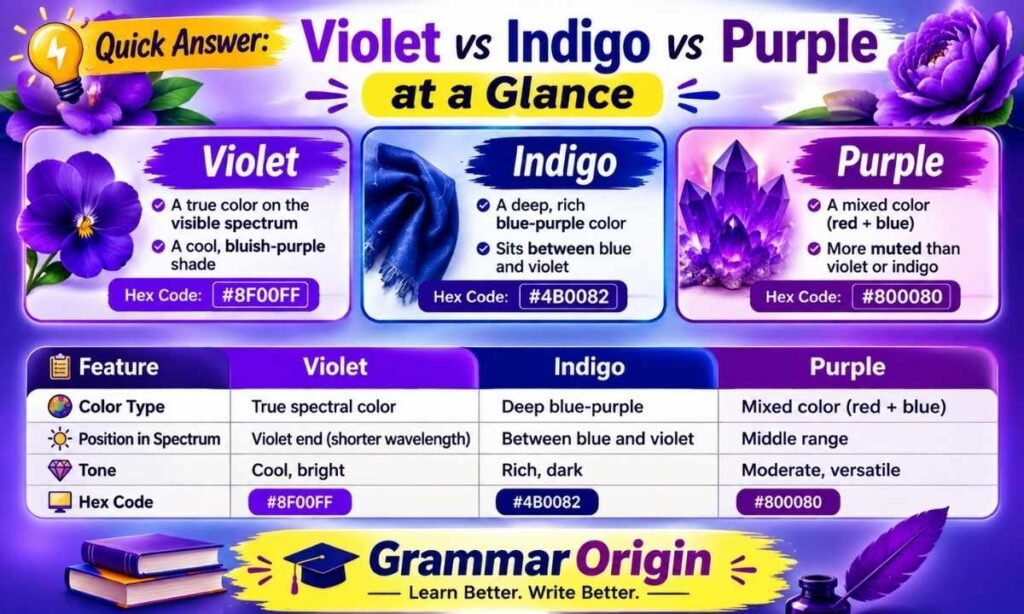
Here’s the short version before we go deeper.
- Violet is a real spectral color. It exists as a single wavelength of light (about 380–450 nm) and appears at the edge of the rainbow.
- Indigo sits between blue and violet. It’s a deep, dark blue-purple, and its status as a true spectral color is still debated by scientists.
- Purple is not a spectral color at all. Your brain creates it by blending red and blue light signals.
| Feature | Violet | Indigo | Purple |
| Spectral color? | Yes | Debated | No |
| Wavelength | ~380–450 nm | ~445–464 nm | None (mixed) |
| Base tone | Blue-leaning | Deep blue-violet | Red + blue mix |
| Common example | Violet flowers | Indigo denim | Purple grapes |
If you remember nothing else: violet is light, indigo is a transition shade, and purple is a blend.
Scientific Definitions: Where Each Color Sits on the Spectrum
Short answer:Violet and indigo are wavelengths of visible light. Purple is not — it only exists in your brain.
Understanding violet vs indigo vs purple starts with how light itself works. Light travels in wavelengths, and the human eye can see a narrow slice of them, roughly 380 to 700 nanometers (nm). Violet sits at the short-wavelength end of that range, around 380–450 nm. This is why violet always appears at the edge of a rainbow, right before invisible ultraviolet light begins.
Indigo is trickier. Isaac Newton placed it between blue and violet, at roughly 445–464 nm, mostly to make the rainbow fit his preferred set of seven colors. Many modern color scientists argue indigo isn’t a truly distinct spectral band — it’s really a darker shade of blue-violet.
Purple works differently. There’s no single wavelength of light that looks purple. Your brain builds it by combining signals from red and blue light receptors at the same time. That’s why purple is called a “non-spectral” color — it exists in perception, not in the light spectrum itself.
Visual Differences: How to Tell Them Apart
Short answer: Violet looks cool and blue-leaning, indigo looks dark and navy-like, and purple looks warmer with a visible red tint.
Once you know what to look for, spotting the difference between violet vs indigo vs purple gets much easier. A few quick visual cues:
- If it looks closer to blue and slightly cool, it’s probably violet.
- If it looks dark, almost navy, with a purple hint, it’s likely indigo.
- If it looks reddish or warm, it’s purple.
Lighting changes how these colors read. Warm indoor light can push violet toward purple, while cool daylight can push purple toward violet. When in doubt, compare the color next to a pure red and a pure blue swatch — whichever it leans toward tells you the answer.
Violet vs Indigo vs Purple: Hex, RGB & Pantone Codes
Short answer: In digital design, violet is commonly #8F00FF, indigo is #4B0082, and purple is #800080.
For anyone working in design, knowing the exact codes for violet vs indigo vs purple removes the guesswork. These are the standard reference values:
| Color | Hex Code | RGB | Approx. Feel |
| Violet | #8F00FF | 143, 0, 255 | Bright, saturated blue-purple |
| Indigo | #4B0082 | 75, 0, 130 | Dark, muted blue-purple |
| Purple | #800080 | 128, 0, 128 | Balanced, mid-tone red-blue |
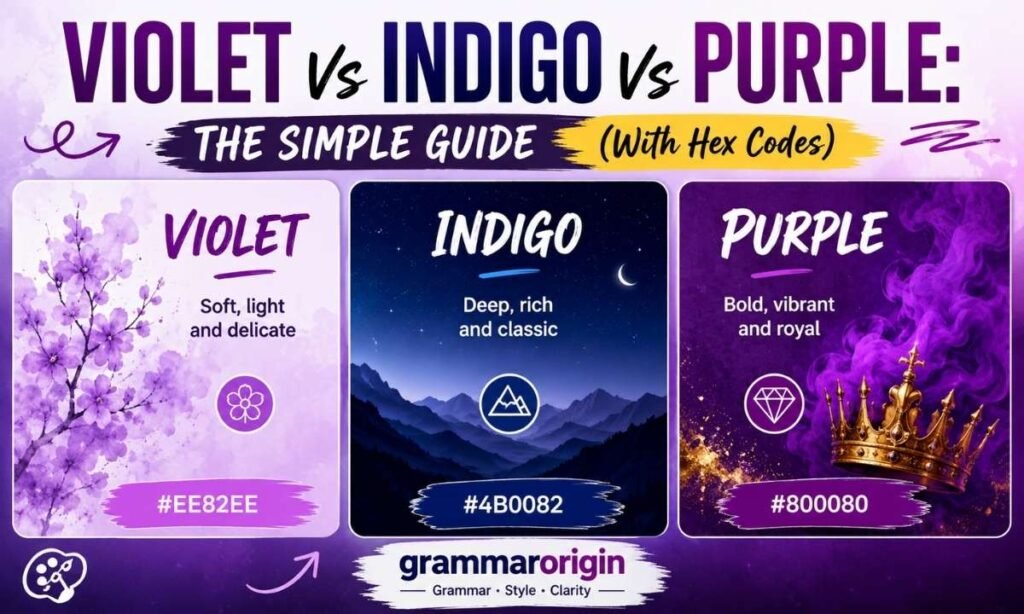
A quick note on naming: the CSS web color called “violet” (#EE82EE) is actually a soft, light pinkish-purple — not the deep, saturated violet you’d see in a rainbow. When you’re picking a screen color, check the actual hex value rather than trusting the name alone, since “violet” and “purple” labels vary across design tools.
For paint and print work, ask your supplier for the closest Pantone match to these hex values, since Pantone numbers shift slightly by product line and can’t be matched with 100% precision from RGB alone.
READ MORE ABOUT In Process or In Progress?
History & Symbolism: What Each Color Represents
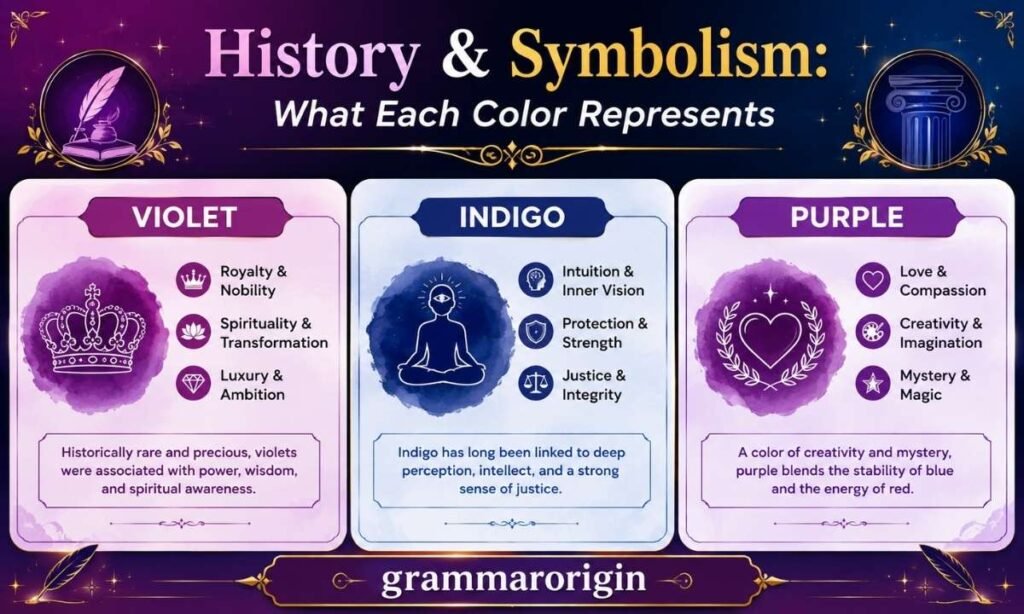
Short answer:Violet symbolizes spirituality, indigo represents depth and intuition, and purple has long stood for royalty and wealth.
Purple carries the strongest historical weight of the three. In ancient times, Tyrian purple dye was made by crushing thousands of sea snails to produce a tiny amount of color. It was so expensive that only emperors and nobles could afford it, which is why purple became permanently linked to royalty and status.
Indigo has a different story. The dye came from the indigo plant and shaped entire economies — it was central to trade in India, Japan, and West Africa for centuries. It’s also the reason blue jeans are, technically, dyed indigo rather than blue.
Violet’s history leans more spiritual than commercial. It appeared often in stained glass, religious robes, and medieval art, where it symbolized wisdom, mysticism, and higher thought — meanings that still show up in modern branding for wellness and meditation products.
Color Mixing in Art and Design
Short answer: Violet is blue with a touch of red, indigo is a deep blue with a hint of violet, and purple is roughly equal parts red and blue.
| Color | Pigment Mix | Digital (RGB) Approach |
| Violet | Blue + small amount of red | Increase blue, add limited red |
| Indigo | Deep blue + touch of violet or black | Push blue darker, add slight violet |
| Purple | Roughly equal red and blue | Increase red and blue evenly |
The ratio matters more than people expect. A slightly higher proportion of blue keeps a mix cool and closer to violet or indigo. A slightly higher proportion of red pushes it warmer, toward purple. This holds true whether you’re mixing paint, adjusting a digital palette, or picking fabric dye.
One practical tip across mediums: watercolor tends to dry lighter than it looks wet, acrylic can shift slightly toward blue as it dries, and oil paint usually produces the richest, most saturated purple tones of the three.
How These Colors Compare to Magenta
Short answer:Magenta is a brighter, pinker non-spectral color made from equal parts red and blue light — it sits closer to pink than violet, indigo, or purple do.
Magenta often gets grouped with this trio, but it’s a distinct color. Like purple, magenta doesn’t exist as a single wavelength — it’s created when red and blue light combine in roughly equal, high-intensity amounts. The key difference is intensity and warmth: magenta reads brighter and pinker, while purple stays more muted and violet stays cooler and more blue.
A simple way to separate them: if it looks vivid and almost hot pink, it’s magenta. If it looks deep and jewel-toned, it’s purple. If it looks pale and cool, it’s violet.
Violet vs Indigo vs Purple in Clothing & Fashion
Short answer:Indigo dominates denim, violet shows up in soft, pastel pieces, and purple is the go-to for bold, statement clothing.
Indigo is the most common of the three in fashion, mainly because of denim — most “blue jeans” are dyed with indigo, giving them that slightly darker, purple-tinted blue. Violet appears more in lighter, softer pieces: pastel dresses, scarves, and accessories aimed at a delicate look. Purple is the boldest choice of the three and is often used for statement pieces, formalwear, and branding that wants to signal luxury or creativity.
If you’re shopping and unsure which one you’re looking at, check the item in natural light — store lighting can make indigo look more purple or violet look duller than it really is.
Violet vs Indigo vs Purple in Paint
Short answer: For walls and home decor, violet and purple are the common choices; indigo is rare in interior paint and usually shows up as a deep accent shade.
Paint brands mostly sell shades under the “purple” or “violet” family names, with indigo appearing occasionally as a very dark accent color rather than a standalone paint line. If you’re choosing wall paint, look at the undertone in the swatch: a cooler, blue-heavy sample leans violet, while a warmer, red-heavy sample leans purple. Always check paint swatches in the room’s actual lighting before deciding, since artificial light can shift these tones noticeably.
These Colors in Nature
Short answer: Violet appears in flowers like lavender and violets, indigo shows up in deep ocean water and certain berries, and purple is common in fruits like grapes and plums.
Nature is a good place to see violet vs indigo vs purple side by side, since all three show up in plants and fruit.
Violet in nature comes largely from anthocyanin pigments in flowers, which shift shade depending on soil pH — this is why lavender and violets can look slightly different from one plant to the next. True indigo is harder to find in nature outside of the indigo plant itself, though deep blue-violet tones appear in some berries and minerals. Purple is more common than either, showing up in grapes, plums, eggplants, and certain flowers like iris and clematis.
READ MORE POSTS ABOUT In Process or In Progress?
Color Blindness: How Perception Differs
Short answer: People with red-green color blindness, the most common type, often struggle to tell violet, indigo, and purple apart, since all three rely on distinguishing red and blue components.
Most color blindness involves difficulty separating red and green, but it also affects how well someone can judge the red component inside a color. Since purple depends heavily on red, and violet and indigo depend more on blue, people with red-green color vision deficiency may see purple as closer to blue, or struggle to notice the difference between indigo and violet at all. This is worth keeping in mind for design work — if a distinction between these colors matters (like in a chart or infographic), don’t rely on color alone; add labels or patterns as backup.
READ
Practical Identification Guide
Short answer: Look at the color next to blue and red — the one it leans toward tells you what it is.
Whether you’re shopping, painting, or designing, this quick guide to violet vs indigo vs purple should settle any doubt. A simple checklist for identifying these colors on sight:
- Looks cool and bluish → Violet
- Looks dark, almost navy, with a purple tint → Indigo
- Looks warm or reddish → Purple
| Everyday Item | Likely Color |
| Lavender flowers | Violet |
| Blue jeans | Indigo |
| Amethyst gemstone | Purple |
| Navy paint with a purple tint | Indigo |
| Grape skin | Purple |
Always check the color in both natural daylight and indoor lighting — the difference between violet, indigo, and purple can shift noticeably depending on the light source.
Frequently Asked Questions
Is violet the same as purple?
No. Violet is a real spectral color made of a single wavelength of light. Purple is created when the brain blends red and blue signals, so it isn’t a spectral color at all.
Is indigo really part of the rainbow?
Traditionally yes — Isaac Newton included it as the seventh color. Many modern scientists debate whether it’s truly a distinct spectral band or just a darker shade of blue-violet.
Why is purple associated with royalty?
Because Tyrian purple dye, made from thousands of crushed sea snails, was extremely expensive in ancient times. Only emperors and nobles could afford clothing dyed with it.
What’s the easiest way to tell violet vs indigo vs purple apart?
Compare the color next to red and blue. Violet leans cool and blue, indigo looks dark and navy-toned, and purple leans warmer with a visible red tint.
What are the hex codes for violet, indigo, and purple?
Common hex codes are #8F00FF for violet, #4B0082 for indigo, and #800080 for purple, though exact shades can vary by design tool or paint brand.
Is magenta the same as purple?
No. Magenta is brighter and pinker, made from a high-intensity mix of red and blue. Purple is more muted and jewel-toned by comparison.
Final Thoughts
Violet, indigo, and purple may look alike at a glance, but they each have a distinct identity. Violet is a true spectral color, indigo is a debated transition shade between blue and violet, and purple is a non-spectral blend your brain creates from red and blue light.
Knowing the difference between violet vs indigo vs purple helps with everything from choosing paint and clothing to picking the right hex code for a design project. Next time you’re unsure which one you’re looking at, a quick check against red and blue light — or the hex codes above — will give you the answer.

Muhammad Waqas is an English language teacher and grammar expert with over 8 years of experience helping students and professionals improve their writing skills. He specializes in English grammar, vocabulary, communication, and practical language learning. Through GrammarOrigin, Waqas shares clear, easy-to-understand content that helps readers write and speak English with confidence.