
If you’ve ever stopped mid-sentence wondering whether to write how to, how-to, or how-tos, you’re not alone. This small phrase causes big confusion, especially in titles and headings.
The debate over how to vs how-tos usually comes down to two questions: when do you hyphenate, and how do you pluralize? This guide answers both clearly, with real examples and simple rules you can apply right away.
Understanding What “How-To” Really Means
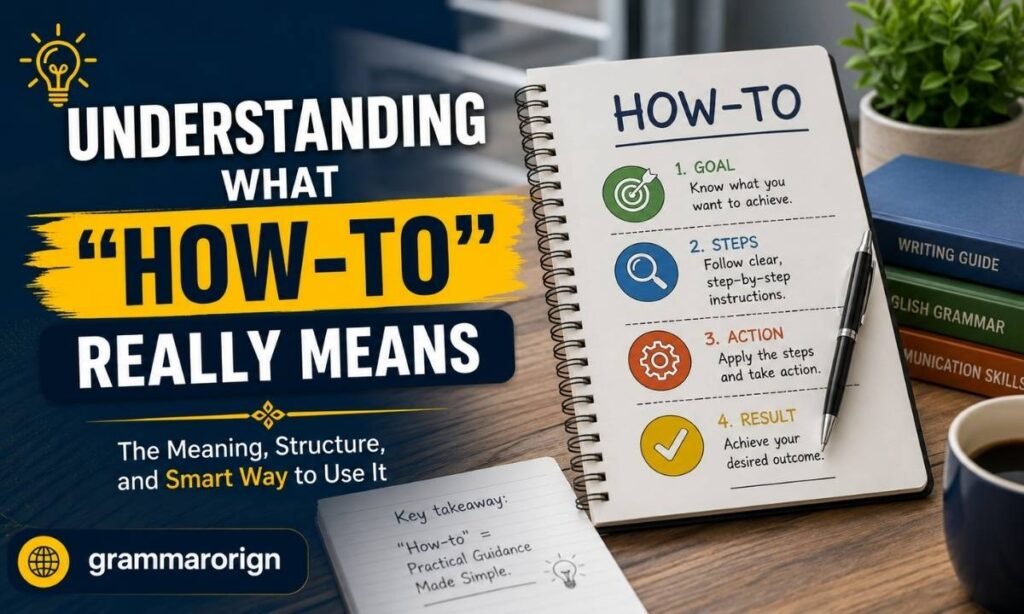
“How-to” isn’t one fixed word. It changes form — and its grammar rules change with it — depending on the job it does in a sentence.
As a Noun
It can work as a noun — a thing you can read, write, or share:
- “I bookmarked a great how-to on baking bread.”
As an Adjective (Modifier)
It can also work as an adjective, describing another noun:
- “She filmed a how-to video for her channel.”
As a Verb Phrase
And it can appear as a plain verb phrase, with no hyphen at all:
- “Nobody showed me how to fix this.”
Once you know which role the phrase is playing, the hyphenation and pluralization questions become much easier to answer.
When You Should Hyphenate “How-To”
The hyphen isn’t optional decoration — it changes what the words mean, and it’s part of correct grammar rules for compound modifiers.
Hyphenate “How-To” When…
- It functions as a noun (“This how-to is short and clear.”)
- It sits before a noun as a modifier (“a how-to guide,” “a how-to lesson”)
Don’t Hyphenate When…
- “How to” introduces an action or infinitive verb (“Learn how to cook.”)
- The phrase describes what someone does, not what something is
A quick test: if you can swap “how-to” for “tutorial” or “guide” and the sentence still makes sense, hyphenate it. If it describes doing something, leave the hyphen out.
Quick Reference Chart
| Sentence Example | Correct Form | Why |
| “Read this ___ before starting.” | how-to | Functions as a noun |
| “Watch the ___ video first.” | how-to | Modifies a noun |
| “She knows ___ fix it.” | how to | Verb phrase, no compound |
| “These ___ are helpful.” | how-tos | Plural noun |
| “I learned ___ code.” | how to | Infinitive clause |
The Plural Problem: “How-Tos” vs. “How To’s”
This is where most writers actually get stuck. Three versions show up online:
- how-tos
- how-to’s
- how to’s
Only one of these is standard in modern English. The other two are common, but incorrect.
Why “How-Tos” Is the Correct Plural Form
English pluralizes hyphenated compound nouns by adding an “s” to the end of the whole term — no apostrophe involved.
- how-to → how-tos
- check-in → check-ins
- follow-up → follow-ups
The pattern is consistent across all three examples, and “how-to” follows it exactly.
Why “How-Tos” Wins
- It matches standard pluralization rules for hyphenated compound nouns
- It avoids mixing up plural and possessive meaning
- Merriam-Webster lists “how-to” as a noun entry (see the official dictionary entry), and major style guides — including AP and Chicago — support the hyphenated plural for consistency and readability
Why “How To’s” Fails
“How to’s” fails on two counts at once: it drops the hyphen and adds an apostrophe that doesn’t belong there. It’s easy to see why it spreads — informal writing travels fast, and autocorrect doesn’t flag grammar, only spelling.
Simple rule to remember: keep the hyphen, drop the apostrophe, add “s.”
Read More Related Post Tomatoes or Tomatos?
The Possessive Form: “How-To’s”
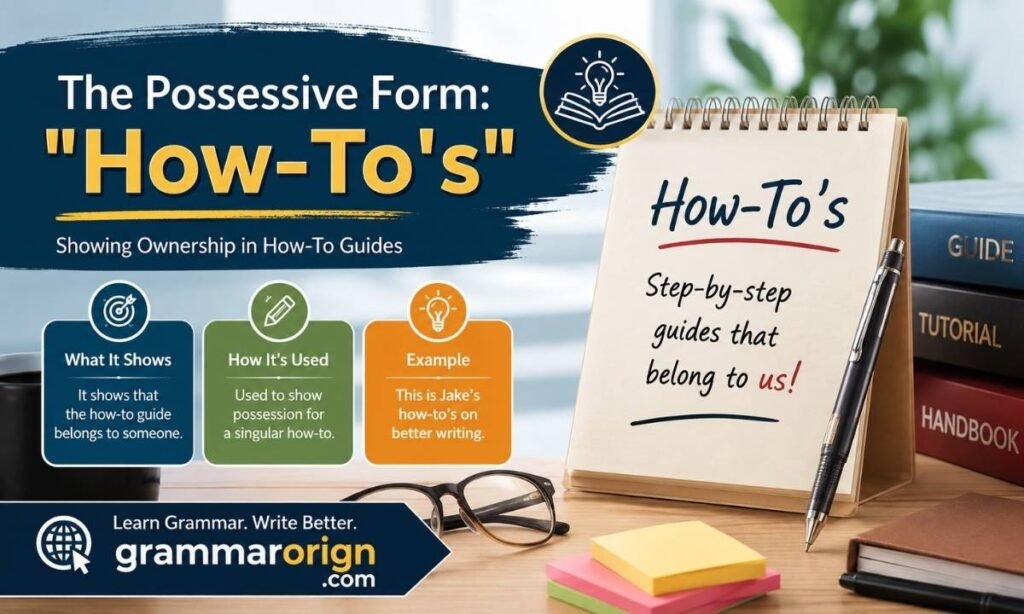
There’s one narrow case where the apostrophe version is actually correct — possession.
Apostrophes in English do two jobs: show a contraction, or show ownership. They don’t create plurals.
So “how-to’s” is valid only when something belongs to the how-to:
- “The how-to’s instructions were confusing.” (the instructions belong to the how-to)
This is rare in everyday writing, since “how-to” isn’t usually described as owning something. Outside of this exact possessive use, skip the apostrophe entirely. If you’re referring to more than one guide, you want how-tos, not how-to’s.
Using “How-To” as a Noun Modifier (Adjective Position)
When “how-to” sits directly before another noun, it acts as a compound modifier, and the hyphen becomes non-negotiable.
Examples:
- how-to guide
- how-to tutorial
- how-to video
- how-to blog
Table: Correct vs. Incorrect Usage
| Incorrect | Correct |
| how to guide | how-to guide |
| how to article | how-to article |
| how to tips | how-to tips |
| how to section | how-to section |
Drop the hyphen here, and the phrase looks like two loose words instead of one connected idea — the sentence gets harder to read at a glance.
How to Capitalize “How-To” in Titles & Headlines
Capitalization rules for “how-to” follow standard title case rules for hyphenated compounds, but writers often get this wrong.
The rule: in title case, capitalize both parts of a hyphenated compound when each part would normally be capitalized on its own.
- Correct: “10 How-To Tips for Beginners”
- Correct: “The Best How-Tos for New Writers”
- Incorrect: “10 How-to Tips for Beginners” (the second half stays lowercase, which breaks title case consistency)
Some style guides lowercase short function words after a hyphen (like “to” in other contexts), but “how-to” is treated as a single compound noun or modifier — so both halves get capitalized in headline case. Sentence case headings only capitalize the first word, so “How-to” is fine there.
Common Misunderstandings About “How-To” and Its Plural
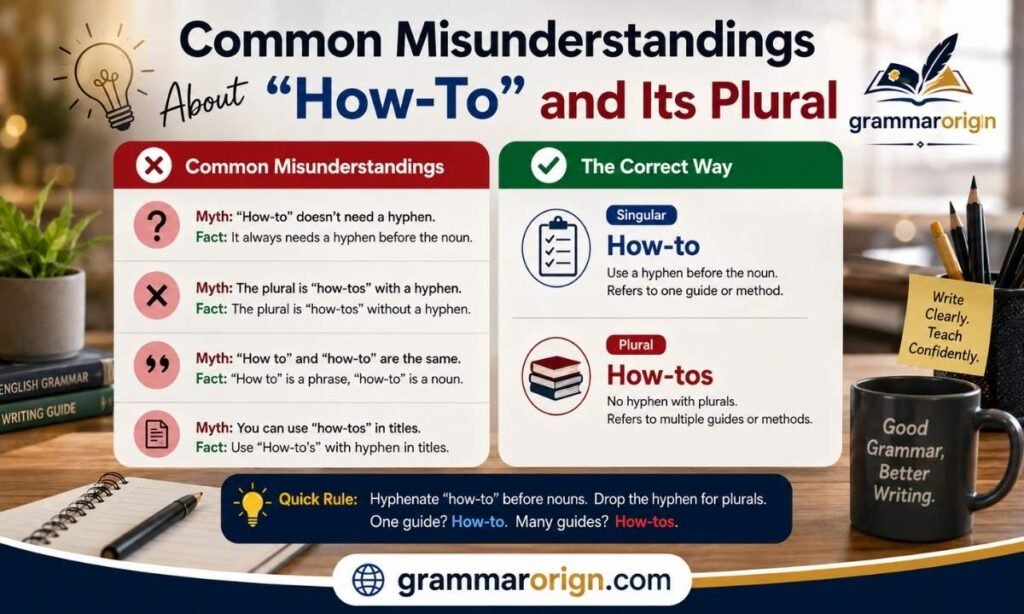
A few recurring mistakes cause most of the confusion around this phrase.
Misunderstanding #1: Treating “How To” as a Noun Without a Hyphen
Incorrect: “Did you read that how to?” Correct: “Did you read that how-to?”
Misunderstanding #2: Putting the Plural “S” in the Wrong Spot
Incorrect: “how’s-to” Correct: “how-tos”
Misunderstanding #3: Assuming the Apostrophe Looks “Cleaner”
“How-to’s” might look tidy, but it signals possession, not plural — and readers notice the syntax mismatch even when they can’t explain why.
Similar Compound Nouns: Go-To, Check-In, Sign-In
“How-to” isn’t the only hyphenated compound that trips writers up. The same pluralization rule applies across a whole family of similar words.
| Singular | Plural |
| how-to | how-tos |
| go-to | go-tos |
| check-in | check-ins |
| sign-in | sign-ins |
If you’ve ever wondered whether it’s “go-tos or go-to’s,” the answer follows the exact same logic as “how-tos”: add an “s” to the end, skip the apostrophe.
- “These are my go-tos for weeknight dinners.”
- “The app tracks all your sign-ins automatically.”
Once you learn the rule for one of these compounds, it applies to the rest without extra memorizing.
Read More Related Post Tomatoes or Tomatos?
Workarounds: Avoiding the Need to Pluralize “How-To”
Sometimes the easiest fix is a small rewrite that skips the plural question entirely.
Useful Alternatives
- guides
- tutorials
- walkthroughs
- instructional content
- step-by-step articles
Rewrite Examples
- Instead of “These how-tos are outdated,” try “These guides are outdated.”
- Instead of “I’m writing several how-tos,” try “I’m writing several tutorials.”
This isn’t a weaker choice — it’s often the more natural-sounding option, especially in casual writing.
Practical Usage: “How-Tos” in Real-World Context

Seeing the word in everyday use helps the rule stick.
Technology
“The site publishes coding how-tos for beginners.”
DIY and Home Improvement
“Their woodworking how-tos are detailed and easy to follow.”
Business
“Leadership how-tos get steady monthly traffic on the blog.”
Education
“Students respond well to interactive how-tos in digital lessons.”
Publishing teams often standardize this term across their content to avoid the how-to vs how-tos mix-up entirely. Once a style rule is set — how-to as noun/adjective, how-tos as plural — editorial consistency improves, drafts need fewer corrections, and the content reads with more clarity overall.
Frequently Asked Questions
What Is the Correct Plural of “How-To”?
The correct plural is how-tos — keep the hyphen, add only an “s,” no apostrophe.
Is It “How Tos” or “How-To’s”?
“How-tos” (or the less formal “how tos” without a hyphen) is correct. “How-to’s” is grammatically wrong outside of possession.
Should “How-To” Always Be Hyphenated?
No. Hyphenate it when it’s a noun or a modifier before a noun. Skip the hyphen when it’s part of a verb phrase, like “learn how to swim.”
Can “How-To’s” Ever Be Correct?
Yes, but only to show possession — for example, “the how-to’s instructions.” As a plural, it’s incorrect.
Is “How To” and “How-To” the Same Thing?
Not quite. “How to” is a verb phrase describing an action. “How-to” is a noun or adjective describing a thing, like a guide or tutorial.
Does the Same Plural Rule Apply to Words Like “Go-To”?
Yes. Compounds like go-to, check-in, and sign-in all pluralize the same way: add “s” at the end, no apostrophe — go-tos, check-ins, sign-ins.
Why Do So Many People Still Write “How To’s”?
Mostly habit and informal writing spreading online. Autocorrect catches spelling, not grammar, so the mistake keeps getting copied.
Is “How Tos” Without a Hyphen Acceptable?
It shows up in casual writing, but “how-tos” with the hyphen is the more standard and widely accepted form for formal content.
Final Thoughts
The how to vs how-tos debate comes down to three simple rules: hyphenate when it names or describes a thing, skip the hyphen for actions, and pluralize with just an “s” — never an apostrophe.
Once these rules click, you won’t second-guess this phrase again. Small details like this build reader trust, so it’s worth getting right every time you write.

Muhammad Waqas is an English language teacher and grammar expert with over 8 years of experience helping students and professionals improve their writing skills. He specializes in English grammar, vocabulary, communication, and practical language learning. Through GrammarOrigin, Waqas shares clear, easy-to-understand content that helps readers write and speak English with confidence.