
Commit vs comit: the right spelling is commit, with two m’s. Comit is a common typo. It’s a tiny slip, but readers spot it fast in emails, résumés and even code.
This commit vs comit guide explains what commit means, why the double m exists, and how committed, committing and commitment are spelled. You’ll also get memory tricks, Git examples, a 15-question quiz and clear answers to the questions people search most.
Understanding the Difference Between Commit and Comit
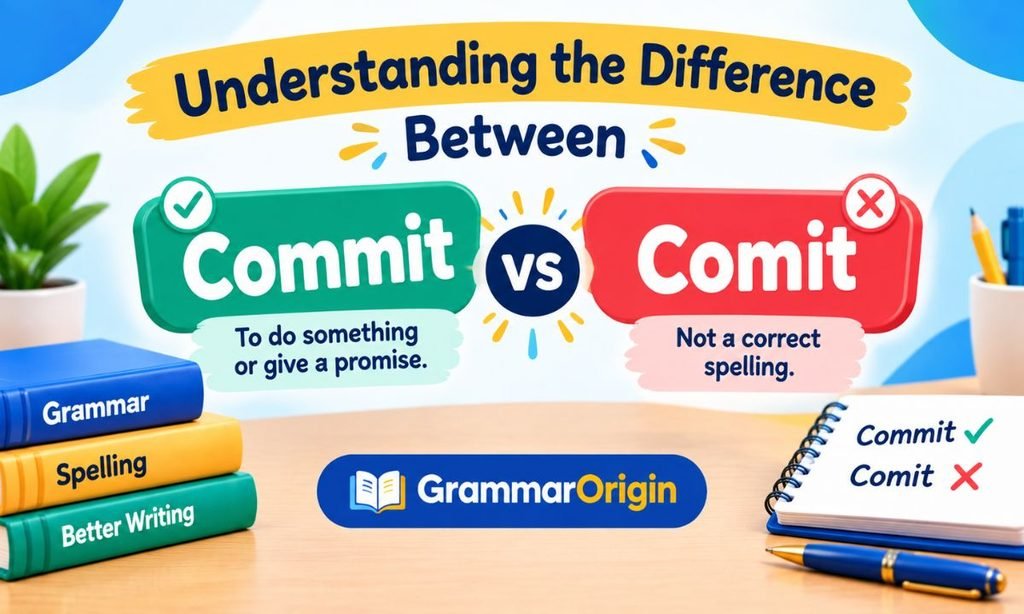
The commit vs comit difference is one letter and one status. Commit is a real English verb, while comit is a misspelling of it. Standard dictionaries list commit with two m’s and give comit no entry at all.
Every other point in the commit vs comit debate grows from that one fact. The rest is about why the second m is there and how to stop dropping it.
Example: ❌ I can’t comit to Saturday yet. ✅ I can’t commit to Saturday yet.
What Does “Commit” Mean?
Commit is a verb that means to pledge yourself, to carry out an act, or to put something into a fixed, recorded state. Which meaning you get depends on what follows the word.
- Pledge or dedicate: She wants to commit to a weekly training plan.
- Perform an act, usually a wrongful one: People commit crimes, errors and blunders.
- Allocate: A company can commit money, staff or time.
- Send to an institution: A court can commit someone to prison or a hospital.
- Record permanently: You commit a poem to memory, or commit code to a repository.
Major dictionaries such as Merriam-Webster and Cambridge list these senses under the same spelling.
Example: Our team decided to commit every Friday afternoon to bug fixes.
Examples of “Commit” in Sentences
These sentences show commit in the way people actually use it. Notice that the spelling never changes, so commit vs comit never depends on the meaning.
- I’ll commit to the Tuesday deadline if the designs arrive on time.
- The council committed $2 million to repairing the bridge.
- He committed the entire speech to memory in one weekend.
- Nobody wants to commit a mistake on the final page.
- Are you committing to the full course or just the first module?
- Her commitment to the project surprised everyone.
- The charity has committed itself to planting 500 trees this year.
- Don’t commit your changes until the tests pass.
Why Do People Write “Comit”?
Mostly because English speech gives no hint that the m is doubled, which fuels the commit vs comit mix-up. You say one m sound, so your fingers type one m.
A few other things push in the same direction:
- Short look-alikes. Words like comic, comet and comedy all have a single m after co-.
- Phone typing. Thumbs skip letters, and autocorrect doesn’t always catch them.
- Skim reading. Your brain fills in the word it expects, so your own typo often looks fine on the page.
- Half-remembered rules. Some writers know English doubles consonants sometimes, but not where.
Example: A quick text like “can u comit to 5pm” is understood, yet the same line in a client email looks careless. Write commit instead.
How to Pronounce Commit
Commit is pronounced kuh-MIT (/kəˈmɪt/), with the stress on the second syllable. American and British speakers say it the same way.
English doesn’t voice a doubled letter twice, so the two m’s sound like one. That’s why your ear can’t settle commit vs comit for you.
Example: Say “I commit” out loud. You’ll hear one m, but you still write two.
Where the Word Commit Comes From
Commit comes from the Latin committere, built from com- (“together”) and mittere (“to send”). It entered English in the late Middle Ages meaning to entrust or hand over.
The two m’s mark the seam where those two pieces meet. The same root mittere also gave English submit, permit, admit, omit, transmit, remit and even promise, which is why promise and commit feel like cousins.
It’s also the quickest answer to commit or comit. You can check the history on Etymonline.
Example: com- + mittere → commit.
Why “Commit” Has Double “M”
Commit has two m’s because the Latin prefix com- ended in m, the root mittere began with m, and English kept both letters. That history is the real answer to commit vs comit, and it isn’t a stress rule.
That distinction matters, because many spelling guides blur it. The doubling rule explains the double t in committed, not the double m in commit.
Example: commit = com + mit, so both m’s stay.
Also Read This Take Effect or Take Affect? Here’s the Correct Phrase to Use
The Double Consonant Rule
The double consonant rule says that when a verb ends in a stressed syllable made of one vowel plus one consonant, you double that final consonant before adding -ed or -ing. Commit fits perfectly: com-MIT, ending in i + t.
Run this three-part test:
- Is the last syllable stressed? (com-MIT, yes)
- Does it end in one vowel and one consonant? (m-i-t, yes)
- Does the ending start with a vowel? (-ed, -ing, yes)
Pass all three, and you double the last letter: committed, committing. Add -ment, which starts with a consonant, and the rule stops.
That’s why commitment has two m’s but only one t. Apply the rule and the comit vs commit confusion disappears from the past tense too.
Example: The board committed the funds, and it’s committing more next year.
Similar Words With Double Consonants
Plenty of English words follow the same pattern, and most of them are cousins of commit. Once you notice the family, the commit vs comit choice gets easier.
| Base word | Past form | Why the letter doubles |
| submit | submitted | Stress on the last syllable |
| permit | permitted | Stress on the last syllable |
| admit | admitted | Stress on the last syllable |
| omit | omitted | Stress on the last syllable |
| occur | occurred | Stress on the last syllable |
| refer | referred | Stress on the last syllable |
A second group gets its double m from the com- prefix, just like commit: common, commute, community, commission and committee.
Example: We submitted the form on Monday. (Not “submited.”)
Words That Don’t Double the Consonant
Words like visit, limit and edit look like commit, but they keep a single t because the stress falls on the first syllable. That’s the exception that muddies commit or comit for many writers.
| Base word | Past form | Stress |
| visit | visited | VIS-it |
| limit | limited | LIM-it |
| edit | edited | ED-it |
| orbit | orbited | OR-bit |
Here’s a quick way to remember it. If you can stress the end of the word, double the letter. If the stress sits at the start, leave it alone.
Example: She visited her cousin in Karachi. (Not “visitted.”)
Common Uses of the Word “Commit”

Commit appears in everyday talk, workplace writing, software and law, and the spelling is identical in all four, so the commit vs comit answer never changes. Only the meaning shifts.
Example: Whether it’s a promise, a budget or a code change, the word is always commit.
Commit in Daily Conversation
In casual speech, commit usually means agreeing to something and sticking with it. It carries more weight than “try” or “hope to.”
People use it for plans, habits and relationships. “I can’t commit to Friday” is polite shorthand for “I’m not sure yet, so don’t count on me.” Texting is where commit or comit slips happen most.
Example: I’d love to join, but I can’t commit until I see my shift schedule.
Commit in Business Writing
In business writing, commit signals a firm promise of time, money or people. It creates an expectation, so it’s stronger than “plan” or “intend.”
If you’re not sure you can deliver, choose a softer verb such as “aim to” or “expect to.” When you’re sure, commit tells the reader they can rely on you. A comit vs commit slip in that sentence weakens the promise.
Example: “We commit to responding to every support ticket within 24 hours.”
Commit in Technology and Programming
In programming, a commit is a saved snapshot of your changes in a version control system such as Git. The word works as both a verb and a noun: you commit code, and each saved snapshot is a commit.
The usual flow is to stage changes with git add and then save them with git commit -m “your message”. Databases use the same idea: a SQL COMMIT makes a transaction’s changes permanent.
Typos happen here too, and commit vs comit is a classic. If you type git comit, Git tells you the command doesn’t exist and, by default, suggests commit as the closest match. You can read more in the official Git documentation.
Example: After testing the fix, Dana ran git commit with a short message.
Git Commit vs Git Push
A commit saves your changes to your local repository, while a push uploads those saved commits to a remote server such as GitHub. They’re two separate steps.
That’s useful in practice. You can commit on a train with no signal, then push everything once you’re back online.
Example: I commit small changes all day and push them once at night.
Commit in Legal Contexts
In legal writing, commit most often means to carry out an offense, or to send someone to custody or care by official order.
Formal writers sometimes swap in “perpetrate” for the first meaning. In legal drafting, commit vs comit isn’t a matter of taste, because only commit is valid.
You’ll see phrases like “accused of committing fraud” or “committed to prison.” Some jurisdictions also use committal for the formal step of sending a case or a person onward.
Example: The report says he was committed to a secure hospital, not to prison.
Commit vs Promise vs Pledge
A promise states an intention, a commitment binds you to action, and a pledge adds a formal or solemn tone. The three overlap, but they’re not interchangeable.
| Word | Feels like | Typical use |
| Promise | “I will.” | Everyday, personal |
| Commit | “I’m bound to do this.” | Plans, work, resources |
| Pledge | “I swear to.” | Formal, ceremonial |
Example: “I commit to reviewing your draft by Tuesday” sounds more binding than “I hope to review it.”
Commit To + Noun or -ing
After commit, the word “to” is a preposition, so it’s followed by a noun or an -ing verb: commit to a plan, commit to finishing. That’s the safest pattern in formal writing.
You’ll sometimes see “commit to do” in speech, but “commit to doing” is cleaner. Other common partners are commit yourself to, be committed to, and commit something to memory.
Example: She committed to finishing the report before the weekend.
Commit vs Comit: Comparison Table
The table below sets commit vs comit side by side so you can check any doubt in seconds. Only one column is correct English.
| Feature | Commit | Comit |
| Spelling status | Correct | Incorrect |
| Number of m’s | Two | One |
| Standard dictionary entry | Yes | No |
| Part of speech | Verb (also a noun in Git) | None in standard English |
| Related forms | commits, committed, committing, commitment | None |
| Safe in formal writing | Yes | No |
| Works as a Git command | Yes | No |
| Legitimate uses | Everywhere | Only as a proper name or label, like the Italian bank Comit |
Example: git **commit** runs. git comit doesn’t.
Real-Life Example of How Spelling Errors Affect Credibility
A single misspelled word rarely ruins a document, but it can change how the rest of it gets judged. Readers treat small errors as clues about the writer’s care, and a commit vs comit slip is a textbook case.
Example: A finance blog that writes “we commit to accuracy” and then misspells it in the same line loses its own point.
Case Study: Resume Rejection Due to Spelling Errors
The scenario below is an illustrative composite, not a named person or company. It mirrors what hiring surveys describe, and it shows how quickly a small error can decide a screening round.
Picture Maya, who applies for a project coordinator role with strong experience. Her cover letter says “I comit to meeting every deadline” and later mentions a “comitment to quality.” The recruiter has 200 applications and about a minute for each one.
Two commit vs comit slips, in the very word about dedication, end up in the “no” pile. Nothing about Maya’s skills changed. Only the first impression did.
The numbers back up the worry, though experts disagree about how fair it is.
A CareerBuilder survey reported by softgarden found 61% of hiring managers would automatically dismiss a candidate over a typo, and 20% spend under 30 seconds on a resume. Some recruiting writers, including a LinkedIn Talent piece, argue that typos are a weak stand-in for real job skill.
The practical takeaway is simple. Search your resume for “comit”, “commited” and “comitment” before you send it.
Example: Change “I comit to deadlines” to “I commit to deadlines.”
Also Read This Take Effect or Take Affect? Here’s the Correct Phrase to Use
Statistics About Spelling Errors in Digital Writing (2025–2026)
Recent surveys agree on one point: visible spelling and grammar errors reduce trust. Where a figure is older than 2025, it’s labeled with its year. The lesson applies to commit vs comit as much as to any other typo.
Example: A product page that says “we commit to quality” but contains three typos sends mixed signals.
Key Data and Trends
Here’s what the most useful recent data shows:
- 65% distrust sites with typos. A Clutch survey on website trust found 65% of shoppers say typos, bad grammar and placeholder text make them distrust a website (Clutch, 2025–2026).
- 80% skipped an oddly spelled domain. GoDaddy’s March 2025 Consumer Pulse survey of 1,500 US consumers found 80% had avoided a site because of a strangely spelled domain name. The figure was 85% for Gen Z and 76% for Gen X and Boomers (Small Business Trends).
- 68% less likely to buy (2022). An Opinium survey for Accuracy Matters found 68% of UK adults would be less likely to buy from a brand with spelling or grammar mistakes (Agility PR).
- Typos and misspellings aren’t judged the same (2017). Indiana University researchers studied nearly 300 people and found that trusting readers forgave misspellings as gaps in knowledge, but read keystroke typos as carelessness (ScienceDaily).
The trend is consistent. Readers forgive rarely, and they decide fast. That last study matters for commit vs comit: “comit” can look like a lazy keystroke slip, which is the harsher judgment.
Example: “I commit to fixing this today” reads as confident. “I comit to fixing this today” reads as rushed.
Why This Matters for SEO
Google has said spelling isn’t a direct ranking factor, but errors can still hurt how readers judge a page and, in extreme cases, how clearly Google understands it. So it’s an indirect issue, not a penalty.
Google’s John Mueller has described spelling as a gray area. Heavy errors can make it harder to tell what a page is about, and they can make good content look low quality (Safari Digital, Engage Web).
Readers also leave faster when a page feels sloppy, and that hurts engagement.
The safe approach is to spell the term correctly in titles, headings and body text. Google usually corrects a mistyped search, but your page still has to get commit vs comit right.
For a query like commit vs comit, searchers want a clean, confident answer, and a page that misspells its own topic can’t give one.
Example: A title tag reading “How to commit code” earns more trust than one reading “How to comit code.”
How to Remember the Correct Spelling of Commit
The easiest way to settle commit vs comit for good is to link the double m to the word’s meaning and its family. Below are three tricks that don’t rely on pure memorization.
Example: Think of commit as a word that holds two things together.
Remember the Double “M”
Think of the prefix com-, which means “together.” The word itself keeps a pair of m’s, so it’s literally “together” spelled with a pair.
A second hook is the letter count. Commit has two m’s and one t, while committed has two m’s and two t’s. Say “mm, then t” and the commit vs comit spelling sticks.
Example: Two m’s for commit, two m’s and two t’s for committed.
Break the Word Into Sounds
Split the word at the syllable break: com | mit. The first syllable ends in m, and the second one starts with m.
Then attach it to its family, so commit or comit never feels like a coin flip. You’d never write “subit” or “permt,” so lean on submit, permit and admit. They all end in -mit, and only the front changes.
Example: com | mit → commit, just like sub | mit.
Use Spell-Checking Tools
Spellcheckers catch “comit” almost every time, so commit vs comit slips rarely survive if you keep them switched on in your browser, email and document editor. Grammarly and Microsoft Editor do the same job.
Developers can add one more safety net. Git can auto-correct a mistyped command, and you can enable it with:
git config –global help.autocorrect immediate
Git only auto-runs the fix when there’s a single close match, so it won’t guess wildly (Adam Johnson’s guide). Code editors and terminals often skip spellcheck, which is where typos slip through.
Example: Your editor underlines comit in red, and you fix it to commit.
Common Grammar Mistakes Related to Commit
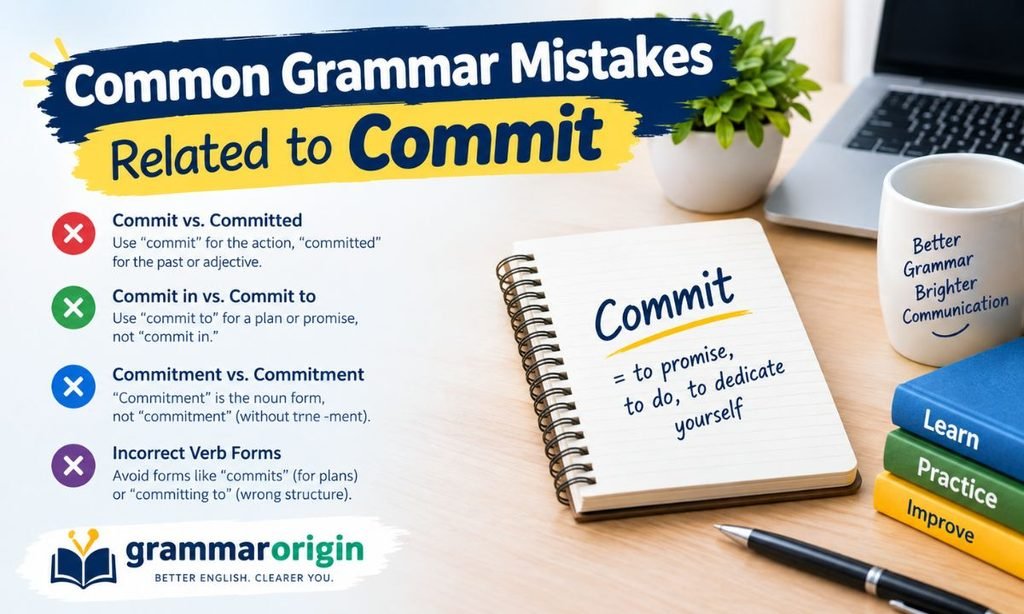
Most slips don’t happen with commit itself but with its endings: committed, committing and commitment. Each ending follows its own small rule. Once commit vs comit is settled, these are the next traps.
Example: We commit now, we committed yesterday, and we’re committing again tomorrow.
Commit vs Committed
Commit is the base form, and committed is the past tense, past participle and adjective. Use commit for the present and committed for anything finished or ongoing.
| Form | Role | Example |
| commit | Base / present (I, you, we, they) | We commit to the plan. |
| commits | Present (he, she, it) | She commits to the plan. |
| committed | Past / adjective | He committed last week. |
| committing | Present participle | They’re committing more time. |
| commitment | Noun | Her commitment shows. |
Example: He is committed to the team, and he committed early.
Correct Examples
These sentences use every form correctly, so you can check them against your own writing whenever commit or comit gives you pause.
- We commit to a two-day turnaround.
- The manager commits extra hours to training.
- Last year, the city committed funds to the library.
- I’m committing to a daily walk this month.
- Their commitment to quality never wavered.
- She’s a committed volunteer.
Example: A committed team commits early and delivers on time.
Incorrect Examples
Each of these is a real-world misspelling from the same comit vs commit family, and each has one simple fix.
| ❌ Wrong | ✅ Right | What went wrong |
| comit | commit | Missing m |
| comited | committed | Missing m and t |
| commited | committed | Missing t |
| comiting | committing | Missing m and t |
| comitment | commitment | Missing m |
| committment | commitment | Extra t |
Example: ❌ She commited to the plan. ✅ She committed to the plan.
Commitment vs Comitment vs Committment
The correct spelling is commitment, with two m’s and one t. The other two versions are common errors, one that drops an m and one that adds an extra t.
The reason is the -ment ending. It starts with a consonant, so the doubling rule doesn’t apply. You keep the base word commit intact and just add -ment.
Example: Long-term commitment takes patience.
Committee vs Comittee
Committee is spelled with two m’s, two t’s and two e’s. It grows out of the same root as commit, so the same letters carry over.
Think of it as commit plus -ee, with the t doubling again. If you’re missing letters, you probably typed “comitee” or “commitee.”
Example: The committee met on Thursday.
British vs American English
Commit, committed and committing are spelled the same in British and American English. There’s no regional split in commit vs comit.
That’s not true for every verb. Travelled and traveled differ by region because their stress sits on the first syllable. Commit’s stress is at the end, so the doubling is standard everywhere.
Example: Both London and Chicago write committed.
Step-by-Step Guide to Avoid Spelling Mistakes
You can cut commit vs comit slips, and errors like them, with five small habits. None of them needs special software.
Example: These habits help you spell commit correctly in every message.
Step 1: Slow Down While Typing
Slowing down at the tricky words is the simplest fix. Most typos happen when you rush through a familiar word.
On a phone, take a half second at words with double letters. Commit, committee and occurrence are the usual culprits.
Example: Pause on “commit” before hitting send.
Step 2: Proofread Carefully
Proofread by searching, not just by reading. Use Ctrl+F or Cmd+F to look for your usual mistakes.
Search for “comit”, “commited” and “comitment.” The search takes ten seconds and catches every commit vs comit slip. You can also read the text backward, one word at a time, which stops your brain from auto-correcting what it expects.
Example: Searching “comit” in a draft turns up “I comit to…” and you fix it fast.
Step 3: Use Grammar Tools
Grammar tools work best as a second pair of eyes, not the final judge. Check each suggestion before you accept it.
Turn spellcheck on everywhere you write, including browsers and code editors. Tools miss wrong-word errors, so they don’t replace a final read.
Example: Your tool flags “comit” and offers commit. Accept it, then reread the sentence.
Step 4: Read More Frequently
Reading builds spelling memory without effort. The more often you see commit in print, the more normal the double m looks.
Documentation, news articles and business emails are good sources. Notice the tricky words as you go, instead of skimming past them.
Example: Reading “the team committed to the schedule” often makes “comited” look wrong.
Step 5: Practice Commonly Misspelled Words
Keep a short personal list of words you’ve gotten wrong before, and review it now and then. Commit is a good first entry, since commit vs comit is such a common slip.
Add its family and lookalikes: committee, commitment, occurrence, recommend and accommodate. Test yourself every week or two.
Example: Your list might start with commit, committed, commitment and committee.
Mini Quiz: Commit vs Comit
Take this 15-question quiz to test what you’ve learned about commit vs comit. The answers appear right under each question.
Example: In every question, the right answer uses commit or one of its correct forms.
1: Spot the Correct Spelling
Which spelling is correct?
- A) comit
- B) commit
- C) commmit
- D) comitt
Answer: B) commit
2: Fill in the Blank
“I can’t ______ to a date until I check my calendar.”
- A) comit
- B) commit
Answer: B) commit
3: True or False
“Comit” is fine as a regular verb in a formal report.
Answer: False. It’s a misspelling of commit.
4: Quick Grammar Check
Which sentence is correct?
- A) We commited the funds last week.
- B) We committed the funds last week.
Answer: B) We committed the funds last week.
5: Choose the Right Meaning
In “The firm will commit resources to the project,” commit means:
- A) to erase
- B) to allocate
- C) to delay
- D) to inspect
Answer: B) to allocate. The firm will commit its resources.
6: Missing Letter Challenge
Fill in the two missing letters: C O _ _ I T
Answer: M and M. The word is commit.
7: Real-Life Writing Test
Which subject line is safe to send to a client?
- A) Can you comit to Friday?
- B) Can you commit to Friday?
Answer: B) Can you commit to Friday?
8: Double Letter Challenge
How many doubled-letter pairs are in “committed”?
- A) One
- B) Two
- C) Three
Answer: B) Two, which are mm and tt. Look at committed.
9: Fast Typing Trap
You type git comit -m “fix bug”. What does Git most likely do?
- A) Saves your changes anyway
- B) Says “comit” isn’t a Git command and suggests commit
- C) Deletes your files
Answer: B) It suggests commit.
10: Sentence Fixer
Fix this sentence: “She was comitted to the plan.”
Answer: “She was committed to the plan.”
11: Past Tense Test
What’s the correct past tense of commit?
- A) commited
- B) comitted
- C) committed
Answer: C) committed
12: SEO Writer Challenge
A blog draft uses “comit” six times. What should you do?
- A) Leave it, since readers will understand
- B) Replace every one with commit, then search for other variants
- C) Change only the title
Answer: B) Replace all with commit, then search for “commited” and “comitment.”
13: One-Word Answer
What’s the noun form of commit that means dedication?
Answer: commitment
14: Professional Writing Check
Which is a legitimate use of the string “comit”?
- A) A verb in a report
- B) A proper name, such as the Italian bank abbreviation Comit
- C) The past tense of commit
- D) A noun meaning promise
Answer: B) A proper name. Everything else should say commit.
15: Final Brain Booster
Which sentence is fully correct?
- A) The comittee commited to the plan.
- B) The committee committed to the plan.
- C) The commitee comitted to the plan.
- D) The committee commited to the plan.
Answer: B) The committee committed to the plan.
Commit Meaning in Relationship
In a relationship, to commit means to choose someone deliberately and put lasting effort into the partnership, usually with the understanding that you’re not looking elsewhere. It’s a decision, not just a feeling.
What that looks like varies. For many couples it means exclusivity, honest communication, shared plans and showing up during hard weeks. Others define it differently, which is why talking openly matters more than any label.
You’ll also hear “commitment issues” in casual talk. It’s an informal phrase for hesitating to settle down, not a medical diagnosis. And note the spelling: commitment, with one t. The same commit or comit rule applies here.
Example: After two years together, they decided to commit to living in the same city.
Is Comit a Word
No. In standard English, comit isn’t a word. In the comit vs commit comparison, only commit has a dictionary entry, and comit is a misspelling.
There are narrow exceptions. Comit is a proper noun in Italy, where it’s the short name of the Banca Commerciale Italiana, and the Comit stock indices, now published by Intesa Sanpaolo, carry the same name (Intesa Sanpaolo). People also use it intentionally in usernames, brand names and code variables.
The test is simple. If you didn’t mean the bank or a deliberate label, it’s a typo. In everyday writing, the answer to “is it commit or comit?” is always commit.
Example: The Comit index tracks Italian stocks, but “I’ll comit to that” is a typo.
Commit to Someone
To commit to someone means to promise your loyalty, time or support to that person and follow through. It works in romance, but also in friendships, family and work.
Grammar-wise, “to” is a preposition here, so a person or an -ing verb follows: commit to her, commit to supporting her.
Be careful with “commit someone” on its own, because that phrase usually means sending a person to a prison or hospital. It’s why “I committed her” sounds alarming.
Better options are I’m committed to her, I commit myself to her, or I made a commitment to her. Even in a heartfelt message, commit vs comit still applies, and it’s commit.
Example: He promised to commit to being there for his sister.
Frequently Asked Questions
Is it commit or comit?
It’s commit. Comit is a misspelling, and it has no standard dictionary entry. In the commit or comit debate, the answer is always two m’s.
Why does commit have two m’s?
Because it comes from Latin committere, made of com- and mittere, and English kept both m’s. That’s the root of commit vs comit. The doubling rule you may have learned explains committed and committing, not the double m in the base word.
Is it committed or commited?
It’s committed, with two m’s and two t’s. The final t doubles because the stress sits on the last syllable of commit. “Commited” is the most common slip after commit vs comit.
What is the noun form of commit?
The noun is commitment, with two m’s and one t. In Git, “commit” itself is also a noun, meaning a saved snapshot of changes.
Is it commit or comit in Git?
It’s commit. If you type git comit, Git reports that the command doesn’t exist and, by default, suggests commit as the closest match. So commit vs comit isn’t a style choice in code, it’s a working command versus an error.
Does spelling affect SEO?
Not directly. Google has said spelling isn’t a ranking factor on its own, but heavy errors can make content look low quality and push readers away. Getting commit vs comit right protects trust and engagement.
Final Thoughts
The commit vs comit question has a one-line answer: write commit, with two m’s, every time. Comit only survives as a proper name, a username or a typo you should fix.
Keep the family together too: committed, committing, commitment. A quick search for any stray commit vs comit slips before you hit send or push will catch the rest.

Muhammad Waqas is an English language teacher and grammar expert with over 8 years of experience helping students and professionals improve their writing skills. He specializes in English grammar, vocabulary, communication, and practical language learning. Through GrammarOrigin, Waqas shares clear, easy-to-understand content that helps readers write and speak English with confidence.